Brat Corps® Community Development Corporation
Building Community Assets. Creating Enduring Value. ™
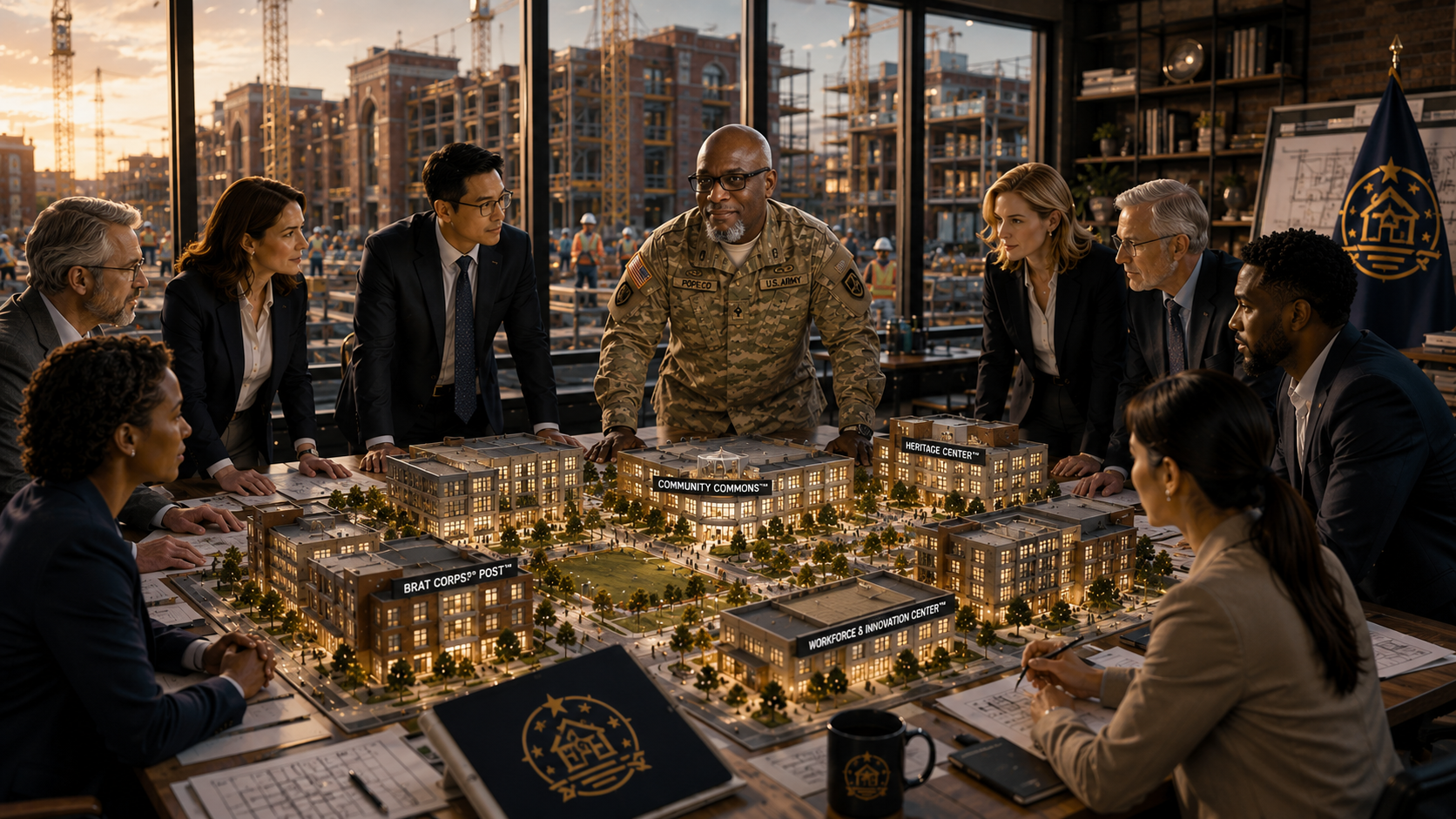
Building Community Assets. Creating Enduring Value.™
The Brat Corps® Community Development Corporation is presented as the implementation and development vehicle within the Military-Connected Destinations™ ecosystem.
It is where municipalities, developers, universities, philanthropy, financial institutions, property owners, and other prospective partners understand how an MCD development opportunity can move toward implementation.
Building Community Assets. Creating Enduring Value.™
Communities are transformed when vision is connected to land, capital, partnerships, development capacity, and long-term stewardship.
The Brat Corps® Community Development Corporation advances place-based development opportunities that strengthen military-connected communities while creating broader economic and community value.
Working within the Military-Connected Destinations™ ecosystem, the CDC can help connect community priorities with development opportunities, public and private partners, institutional resources, and appropriate capital strategies to move high-impact community assets from possibility toward implementation.
We don't develop property for the sake of property. We develop community assets that create belonging, opportunity, and enduring value.™
Explore Development Opportunities | Partner With the CDC
WHY A COMMUNITY DEVELOPMENT CORPORATION?
Vision Requires an Implementation Vehicle.
Destination Excellence™ can establish a framework.
Destination Development™ can identify what a community needs.
A master plan can show what is possible.
But plans alone do not build communities.
Projects require organizations capable of assembling partnerships, coordinating development activities, aligning community objectives, identifying resources, structuring projects, and maintaining focus from concept through implementation.
That is the role envisioned for the Brat Corps® Community Development Corporation.
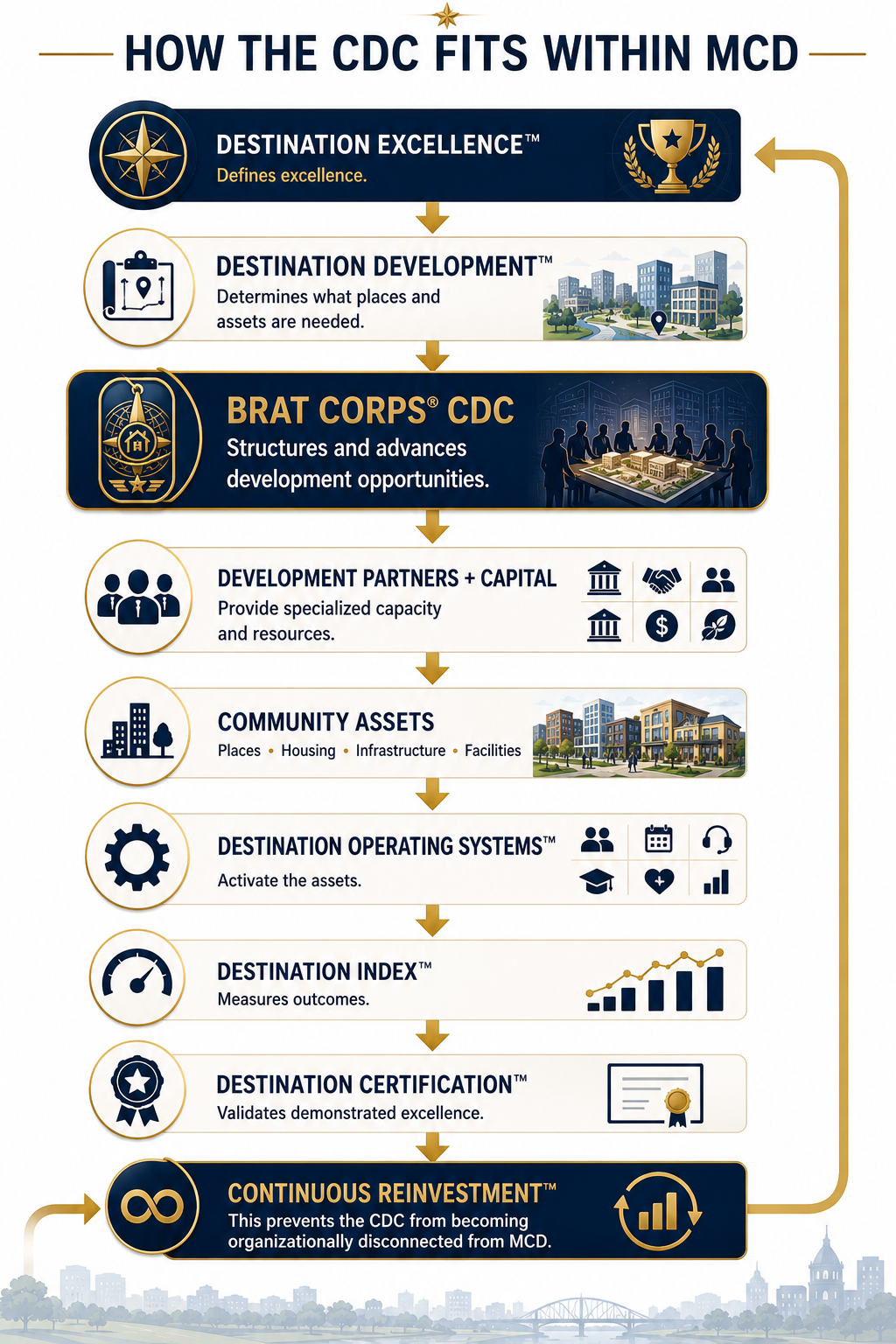
The Institutional Logic
Military-Connected Destinations™
Identifies the destination opportunity.
Destination Development™
Establishes the place-based strategy.
BRAT CORPS® CDC
Structures and advances development opportunities.
Development + Capital + Community Partners
Bring specialized capabilities and resources.
COMMUNITY ASSETS
Housing • Facilities • Public Spaces • Heritage • Education • Workforce • Commerce
ENDURING COMMUNITY VALUE™
THE DEVELOPMENT MANDATE
Development With a Community Purpose.
The CDC's development mandate center on projects capable of strengthening both military-connected people and the communities in which they live.
Potential development categories include:
Community Facilities
Brat Corps® Posts™, Community Commons™, gathering spaces, family resources and community-serving facilities.
Housing
Projects advanced through or aligned with the Military Brat Housing Initiative™, including appropriate affordable, workforce, transitional, mixed-income and intergenerational housing strategies.
Heritage & Cultural Assets
Heritage Centers™, Military Brat Hall of Fame™, archives, museums, cultural spaces, memorial environments and storytelling infrastructure.
Education & Workforce
Learning environments, training centers, credentialing facilities, innovation labs, entrepreneurship spaces and employer-connected workforce hubs.
Mixed-Use Development
Integrated combinations of housing, retail, hospitality, offices, education, community facilities and public spaces.
Commercial & Entrepreneurial Space
Small-business environments, incubators, marketplaces, cafés, retail opportunities and spaces supporting local enterprise.
Public Realm & Community Infrastructure
Parks, plazas, trails, pedestrian environments, public art, recreation and civic gathering spaces.
Adaptive Reuse
Repositioning underutilized buildings, schools, commercial properties, historic structures or other facilities for new community purposes.
NOT EVERY PROJECT SHOULD BE BUILT
The Community Benefit Test™
The existence of available land or capital should not determine whether a project proceeds.
Every proposed CDC project ask:
What documented community need does it address?
Who benefits from the project?
What forms of community capital does it strengthen?
Does it expand opportunity or belonging?
Can existing assets accomplish the objective before new construction is considered?
Is the project financially and operationally sustainable?
Does it complement the surrounding community?
What measurable value should remain?
Who will steward the asset over time?
Development Is the Instrument. Community Benefit Is the Objective.™
FROM OPPORTUNITY TO ASSET™
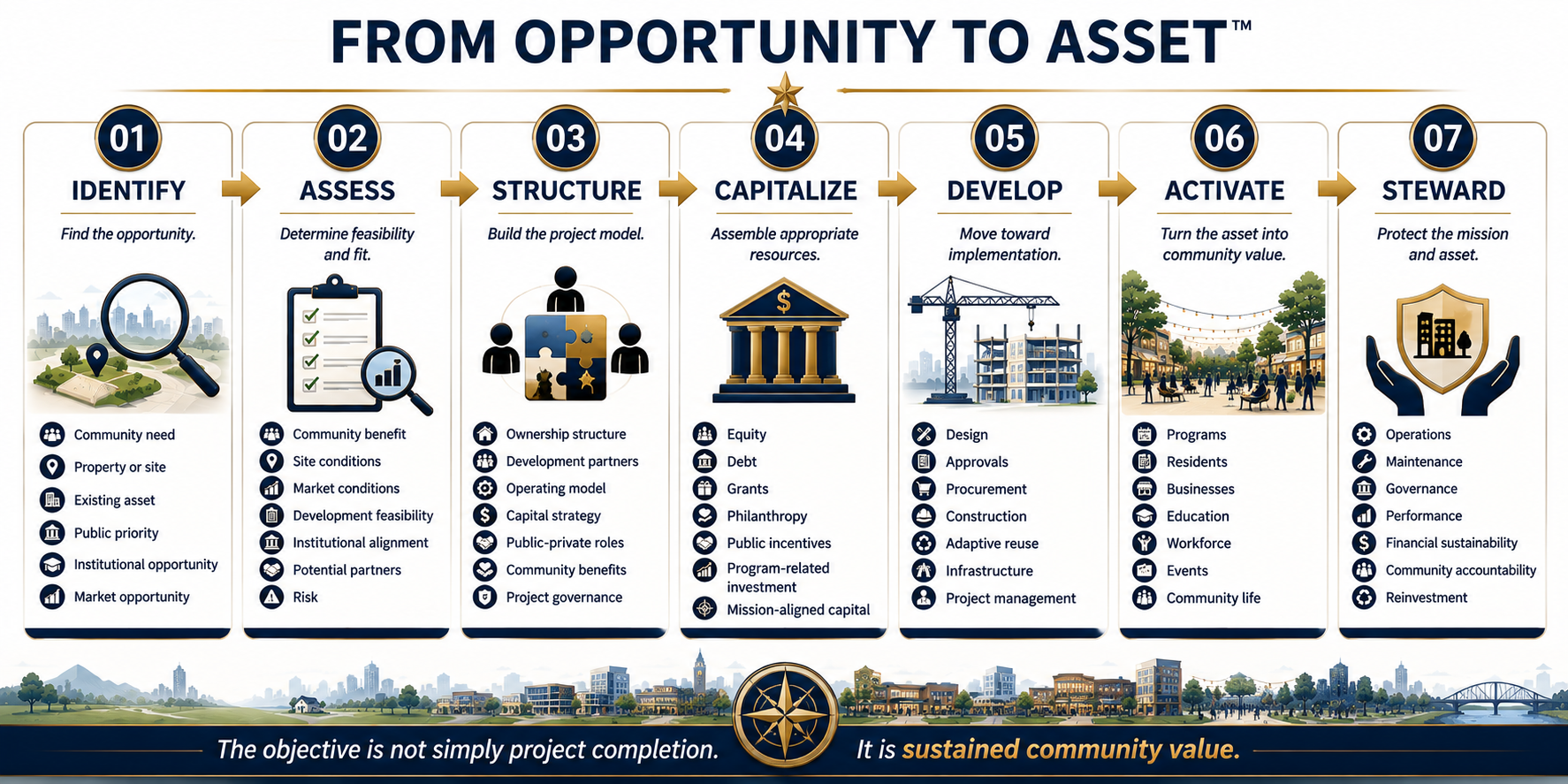
Community Development Is a Team Sport.
The CDC does not position as attempting to perform every development function internally.
Its strength can come from assembling the right capabilities around each project.
Local & State Government
Land • Infrastructure • Planning • Incentives • Public priorities
Developers
Predevelopment • Design • Construction • Project execution
Financial Institutions
Debt • Financial expertise • Community investment
Philanthropy
Grants • Catalytic capital • Capacity building • Mission investment
Universities & Schools
Land • Facilities • Research • Education • Workforce • Programming
Employers
Workforce demand • Investment • Sponsorship • Commercial participation
Community Organizations
Local knowledge • Services • Engagement • Accountability
Military-Connected Institutions
Community connection • Population insight • Programs • Partnerships
Residents
Community priorities • Lived experience • Participation • Stewardship
The CDC does not have to be every partner. It must know how to bring the partners together.
THE PARTNERSHIP MODEL
Different Projects Require Different Capital.
The CDC can seek to help projects identify and coordinate appropriate sources of project capital, subject to project eligibility, underwriting, partner requirements, applicable law, and funding availability.
A project capital stack may potentially include:
Public Resources
Local • State • Federal • Infrastructure • Incentives
Philanthropic Capital
Grants • Foundations • Donor-supported initiatives
Mission-Aligned Investment
Impact investment • Program-related investment • Recoverable capital
Private Equity
Developers • Institutional partners • Qualified investors
Debt Financing
Banks • Community lenders • Qualified financial institutions
Earned Revenue
Lease income • Commercial activity • Facility operations • Events
Community & Institutional Contributions
Land • Facilities • In-kind resources • Partnerships
The precise structure will vary by project.
Capital serves the project. The project serves the community mission.
The Capital Stack™
CATALYTIC CAPITAL™
Closing the Gap Between Vision and Investability.
Before conventional financing becomes available, projects may require:
feasibility studies;
environmental review;
site analysis;
architecture;
engineering;
market studies;
legal structuring;
community engagement;
financial modeling;
or other predevelopment work.
Philanthropy, public resources, institutional contributions, and other mission-aligned capital can sometimes help fund these early activities.
That early investment can move a project from:
IDEA
→ FEASIBILITY
→ INVESTABLE PROJECT
→ DEVELOPMENT
→ COMMUNITY ASSET
This gives philanthropy a role beyond simply funding programs.
It can help create assets that continue producing community value.
COMMUNITY BENEFIT BY DESIGN™
Community benefit should not be something measured only after construction.
It should be designed into the project.
Depending upon the project, community-benefit objectives could include:
local hiring;
small-business participation;
affordable or attainable housing;
military-connected employment;
youth opportunity;
public gathering space;
education and training;
local procurement;
accessibility;
heritage preservation;
environmental resilience;
entrepreneurship;
community services;
and long-term affordability or mission protection.
Community Benefit Is Not an Amenity.
It Is a Design Requirement.™
OWNERSHIP IS NOT THE ONLY MODEL
The CDC retain flexibility rather than implying that it must own every project.
Depending upon legal, financial, and project circumstances, implementation could potentially involve:
CDC Ownership
Joint Venture
Development Partnership
Ground Lease
Master Lease
Operating Partnership
Public-Private Partnership
Institutional Partnership
Third-Party Development With Community-Benefit Agreements
Stewardship or Programmatic Partnership
The correct structure should be determined project by project.
Control the mission—not necessarily every building.
THE MILITARY BRAT HOUSING INITIATIVE™
Housing as Community Infrastructure.
One of the CDC's most consequential development areas can be housing.
Military-connected people encounter different housing challenges across the life course—from family transitions and young-adult mobility to workforce housing, affordability, aging, and intergenerational connection.
The Military Brat Housing Initiative™ provides the specialized framework for examining those needs and developing appropriate responses.
Importantly, this does not become:
housing exclusively for military brats.
The stronger model is housing development informed by military-connected needs while contributing to healthy, inclusive communities.
Explore the Military Brat Housing Initiative™
DEVELOPMENT WITHOUT DISPLACEMENT™
Growth Should Strengthen Communities—not Remove Them.
Destination development can generate investment and property value.
But poorly managed development can also create displacement.
The CDC should therefore consider strategies that support existing residents and businesses as communities improve.
Depending upon the project, this may include:
housing affordability;
local business participation;
community ownership strategies;
mixed-income development;
local hiring;
commercial affordability;
resident engagement;
adaptive reuse;
anti-displacement planning;
and long-term stewardship mechanisms.
A stronger destination should create more opportunity to belong—not fewer people who can afford to remain.
Development Does Not End at the Ribbon Cutting.
A completed project creates a new responsibility.
Someone must maintain it.
Someone must operate it.
Someone must protect its mission.
Someone must measure whether it is producing the intended value.
Someone must prepare it for the next generation.
Therefore, every major CDC project should consider its long-term stewardship model before development begins.
DEVELOPMENT
ACTIVATION
OPERATIONS
MEASUREMENT
REINVESTMENT
STEWARDSHIP
ENDURING COMMUNITY ASSET™
STEWARDSHIP
HOW THE CDC FITS WITHIN MCD
Development Does Not End at the Ribbon Cutting.
A completed project creates a new responsibility.
Someone must maintain it.
Someone must operate it.
Someone must protect its mission.
Someone must measure whether it is producing the intended value.
Someone must prepare it for the next generation.
Therefore, every major CDC project should consider its long-term stewardship model before development begins.
DEVELOPMENT
ACTIVATION
OPERATIONS
MEASUREMENT
REINVESTMENT
STEWARDSHIP
ENDURING COMMUNITY ASSET™
THE DEVELOPMENT PIPELINE™
From One Project to a Portfolio of Community Assets.
As the system matures, the CDC can maintain a development pipeline organized by project stage.
Opportunity
Potential project identified.
Exploration
Community and strategic fit assessed.
Predevelopment
Feasibility, planning and partnerships developed.
Capitalization
Project financing assembled.
Development
Asset constructed or repositioned.
Activation
Programs, businesses, residents and partners occupy the asset.
Stewardship
Performance and community value managed over time.
This creates institutional discipline.
Not every opportunity becomes a project.
Not every project proceeds simultaneously.
And resources can be directed toward opportunities with the strongest combination of community impact, feasibility, strategic alignment, and sustainability.
WHAT SUCCESS LOOKS LIKE
The CDC should ultimately be measured by more than square footage or dollars invested.
Success can include:
community assets created;
housing produced or preserved;
underutilized properties repositioned;
jobs and businesses supported;
community facilities established;
capital attracted into participating destinations;
heritage assets preserved;
public spaces improved;
partnerships created;
community benefits delivered;
and, most importantly:
Communities Stronger Because the Development Occurred.
Every community contains unrealized assets.
A vacant building.
An underused property.
A housing opportunity.
A historic site.
A commercial corridor.
A university partnership.
A piece of public land.
An institution seeking a larger community role.
Or an idea that has never had the development infrastructure necessary to become real.
The Brat Corps® Community Development Corporation exists to help connect those opportunities to purpose, partnership, capital, development, and long-term community value.
Bring Us a Development Opportunity
Partner With the CDC
Explore the Military Brat Housing Initiative™
Explore Destination Development™