MILITARY BRAT HOUSING INITIATIVE™
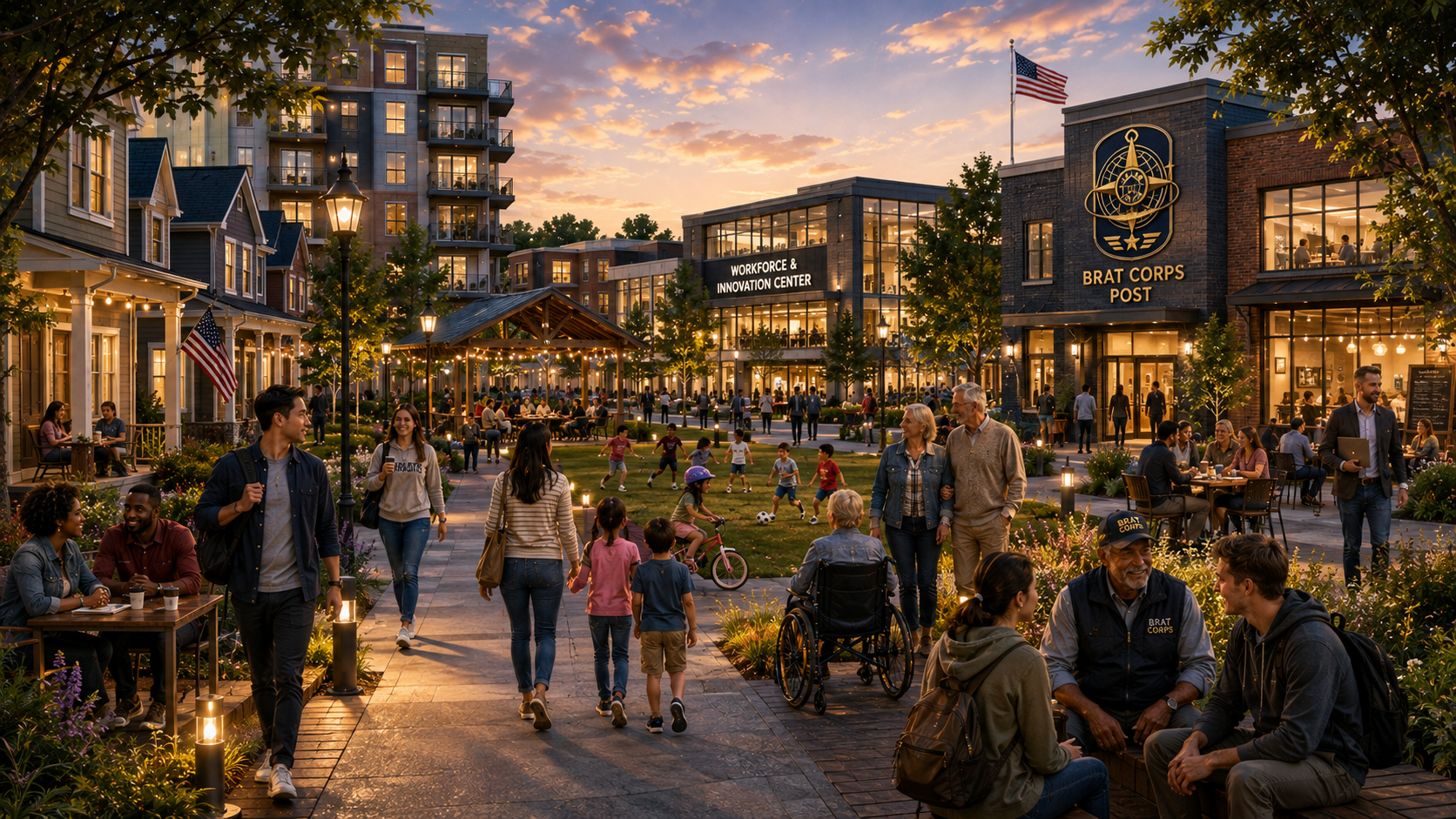
A Place to Live. A Community to Belong To.™
Military-connected people learn to move.
New orders. New bases. New schools. New cities. New relationships. New beginnings.
But eventually another question emerges:
What does it mean to finally have somewhere to belong?
The Military Brat Housing Initiative™ is a place-based housing and community-development framework designed to strengthen residential stability, economic mobility, intergenerational connection, and belonging across the military-connected life course.
Through partnerships with communities, developers, housing organizations, financial institutions, employers, universities, philanthropy, and other institutions, the initiative seeks to advance housing solutions that are connected to the larger environments in which people live, learn, work, gather, and build their futures.
Because housing should provide more than an address.
It Should Provide a Foundation.™
Explore the Housing Model | Partner With the Initiative
A Place to Live. A Community to Belong To.™
Military-connected people learn to move.
New orders. New bases. New schools. New cities. New relationships. New beginnings.
But eventually another question emerges:
What does it mean to finally have somewhere to belong?
The Military Brat Housing Initiative™ is a place-based housing and community-development framework designed to strengthen residential stability, economic mobility, intergenerational connection, and belonging across the military-connected life course.
Through partnerships with communities, developers, housing organizations, financial institutions, employers, universities, philanthropy, and other institutions, the initiative seeks to advance housing solutions that are connected to the larger environments in which people live, learn, work, gather, and build their futures.
Because housing should provide more than an address.
It Should Provide a Foundation.™
Explore the Housing Model | Partner With the Initiative
WHY HOUSING?
Where You Live Shapes What Becomes Possible.
Housing affects nearly every dimension of community life.
It influences:
stability;
education;
employment;
health;
transportation;
wealth creation;
family connection;
social relationships;
access to opportunity;
and ultimately:
belonging.
For military-connected populations, the meaning of home can be especially complex.
Military life can produce extraordinary adaptability and global experience. It can also mean repeated transitions and relationships to many places without necessarily having one permanent geographic home.
The Military Brat Housing Initiative™ brings that lived experience into a broader housing strategy.
Military families learn how to move. Military Brat Housing Initiative™ asks what it takes to finally belong somewhere.
NOT “MILITARY BRATS ONLY”
Military-Informed. Community-Building. Inclusive.
This distinction should be explicit.
The Military Brat Housing Initiative™ should not automatically mean housing reserved exclusively for military brats.
Instead, it is a housing framework informed by military-connected experiences and designed to contribute to healthy, inclusive communities.
Depending upon the project and applicable eligibility requirements, developments could include combinations of:
military brats;
military families;
veterans;
military spouses;
young adults;
working families;
educators;
essential workers;
students;
seniors;
and other community residents.
This prevents isolation and supports a fundamental MCD objective:
Integration Rather Than Separation.™
Military-connected people should be part of thriving communities—not communities apart.
THE HOUSING CONTINUUM™
Different Life Stages. Different Housing Needs. One Connected Strategy.
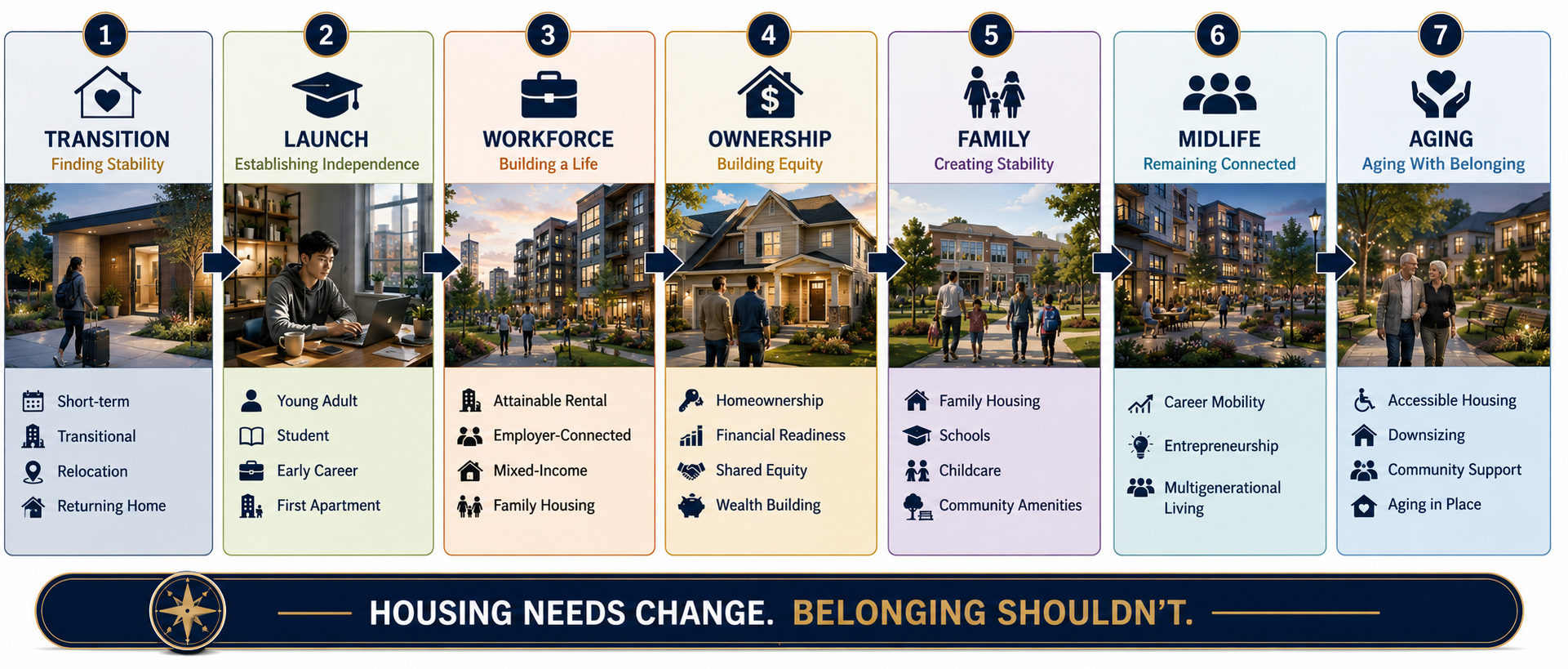
Housing Needs Change. Belonging Shouldn't.™
A building alone does not create belonging.
FROM HOUSING TO HOME™
HOUSING
Safe
Quality
Appropriate
Attainable
STABILITY
Predictability
Security
Continuity
CONNECTION
Neighbors
Community
Institutions
Services
OPPORTUNITY
Education
Employment
Entrepreneurship
Mobility
BELONGING
Identity
Relationships
Participation
Place
HOME™
Housing provides the address. Community creates home.™
THE HOUSING ECOSYSTEM
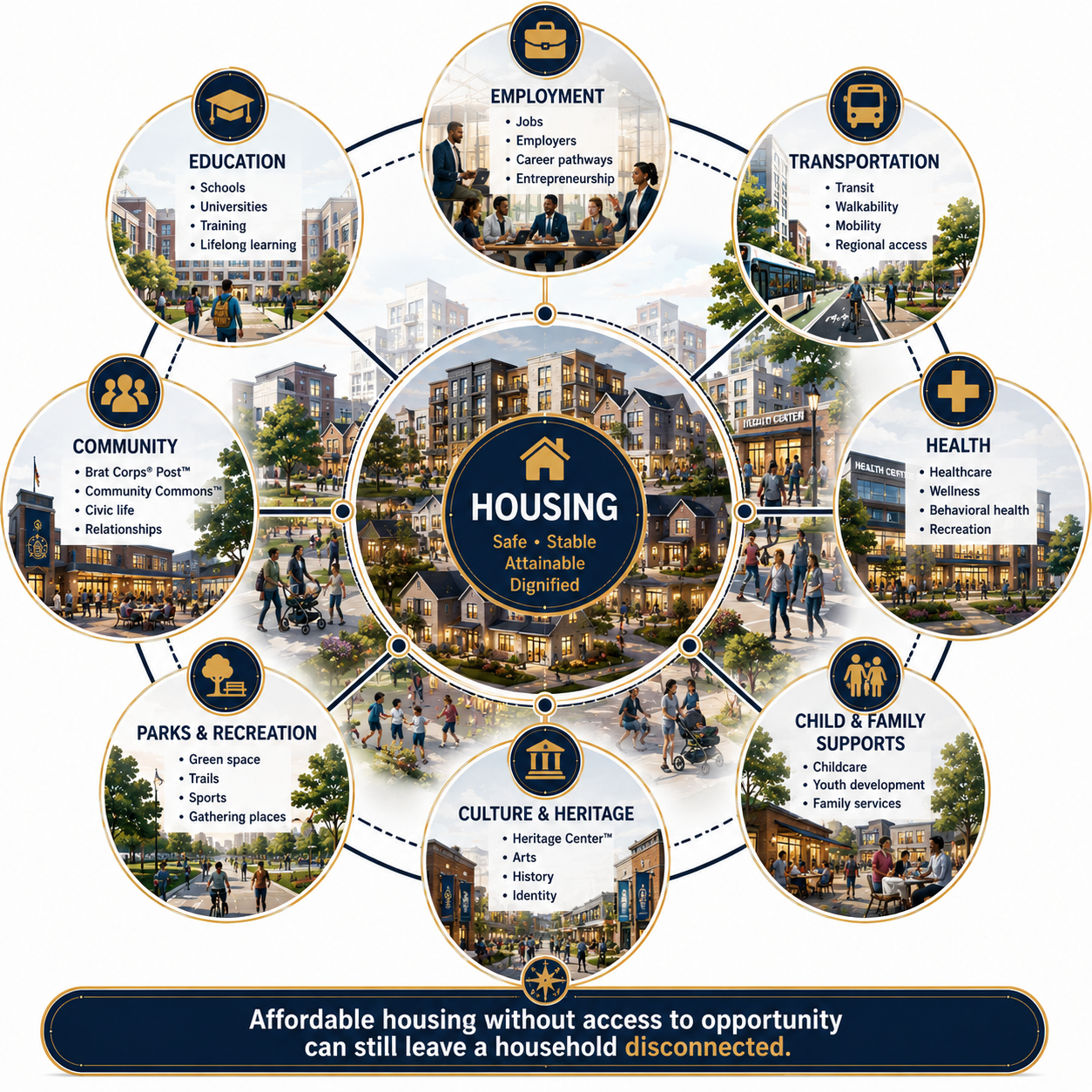
Housing Cannot Be Planned in Isolation.
A successful housing strategy must connect residents to the rest of daily life.
The principle is straightforward:
Affordable housing without access to opportunity can still leave a household disconnected.
MCD therefore connects housing to the destination ecosystem.
HOUSING TYPOLOGIES
One Initiative Does Not Mean One Kind of Housing.
The initiative supports multiple housing models according to documented local need and project feasibility.
Multifamily Rental
Apartments and residential communities serving different household types and income levels.
Accessible Housing
Housing incorporating universal design and accessibility for residents with disabilities or changing mobility needs.
Mixed-Income Housing
Developments incorporating households at different income levels within a shared community.
Senior & Aging-in-Place Housing
Housing environments supporting independence, community connection, accessibility, and aging with dignity.
Workforce Housing
Housing positioned around the needs of workers whose incomes may not align with local housing costs.
Transitional Housing
Time-limited housing models connected to appropriate services or pathways toward stable housing where demonstrated need exists.
Starter Housing
Smaller homes, townhomes, condominiums, or other ownership opportunities designed to help households enter homeownership.
Adaptive-Reuse Housing
Converting appropriate existing buildings into residential communities while preserving community assets and reducing unnecessary demolition.
Intergenerational Housing
Residential environments supporting meaningful connection among younger adults, families, and older residents.
MIXED-INCOME BY DESIGN™
Economic Diversity Can Strengthen Community.
Where feasible and appropriate, mixed-income strategies can place households with different income levels within the same community while connecting them to shared amenities, public spaces, schools, transportation, and opportunity.
The objective is not merely to construct units.
It is to create stable neighborhoods.
Different Incomes. Shared Community.™
THE LAUNCHPAD™
Independence Without Isolation.™
Housing for the Transition Into Adulthood.
This is where the initiative can become particularly distinctive.
Young military brats may leave their parents' household while simultaneously losing some of the institutional environment that surrounded their military upbringing.
College.
Employment.
Military service.
Entrepreneurship.
Civilian life.
Another relocation.
Each pathway requires a new foundation.
The initiative can explore Launchpad™ housing models that combine appropriate residential environments with connections to:
career development;
education;
financial capability;
mentorship;
transportation;
entrepreneurship;
community;
and Brat Corps® networks.
HOMEOWNERSHIP & ECONOMIC MOBILITY
“A home can provide stability. Ownership can also become a pathway to intergenerational assets.”
From Paying for Housing to Building Assets.
Housing strategy should not end with rental development.
For households prepared for ownership, the initiative can connect residents with qualified external resources supporting:
financial education;
homebuyer readiness;
down-payment assistance programs;
mortgage education;
credit preparation;
shared-equity models;
community land trust opportunities;
and other legitimate pathways to sustainable ownership.
Instead, its role can be:
CONNECT
PREPARE
PARTNER
CREATE ACCESS
SUPPORT SUSTAINABLE OWNERSHIP
INTERGENERATIONAL COMMUNITY™
“Don't Warehouse Generations.
Connect Them.™”
Military brat identity does not end at 18.
Neither should community.
Imagine residential environments in which:
a 23-year-old beginning a career;
a 39-year-old raising children;
a 57-year-old entrepreneur;
and a 76-year-old retired military brat
can all belong to the same broader community ecosystem.
Not necessarily in the same building.
But connected through common spaces, Brat Corps® Posts™, mentoring, recreation, heritage, volunteering, education, events, and neighborhood life.
AGING MILITARY BRATS
You Never Age Out of Belonging.™
A Lifelong Community Requires a Lifelong Housing Strategy.
Military brats eventually become older adults.
Some will have strong family networks.
Others may have lived highly mobile lives.
Some may wish to return to places connected to their military upbringing.
Others may seek communities where their identity is understood without explanation.
Housing strategies can therefore consider:
accessible homes;
downsizing options;
aging in place;
walkability;
health access;
transportation;
social connection;
volunteerism;
mentoring;
heritage participation;
and proximity to community amenities
HOUSING + COMMUNITY COMMONS™
The Front Door Opens Into a Community.
Housing developments should not become residential islands.
Where appropriate, housing should connect physically or programmatically to Community Commons™ environments containing:
green space;
cafés;
community rooms;
small businesses;
markets;
recreation;
public art;
events;
learning;
and informal gathering spaces.
This produces an important shift:
UNIT
BUILDING
NEIGHBORHOOD
COMMONS
DESTINATION
BELONGING
HOUSING + BRAT CORPS® POSTS™
A Brat Corps® Post™ can become an important social anchor within or near participating communities.
Residents should not need to receive every service inside their housing development.
Instead, the broader destination provides a network of places.
The Post™ can provide:
community;
mentorship;
events;
leadership;
heritage;
volunteerism;
recreation;
professional networks;
and intergenerational relationships.
This reinforces the distinction between:
where someone lives
and
the community to which someone belongs.
DEVELOPMENT WITHOUT DISPLACEMENT™
Create Housing. Protect Community.
Housing investment can strengthen neighborhoods.
It can also contribute to displacement if community impacts are ignored.
Depending upon local conditions, our initiatives considers strategies involving:
affordability;
mixed-income development;
preservation of existing housing;
adaptive reuse;
resident engagement;
homeownership;
community land strategies;
local hiring;
small-business participation;
and long-term affordability mechanisms.
The goal is not simply to make a neighborhood more valuable. It is to make sure people can continue to belong to it.
HOW PROJECTS MOVE FORWARD
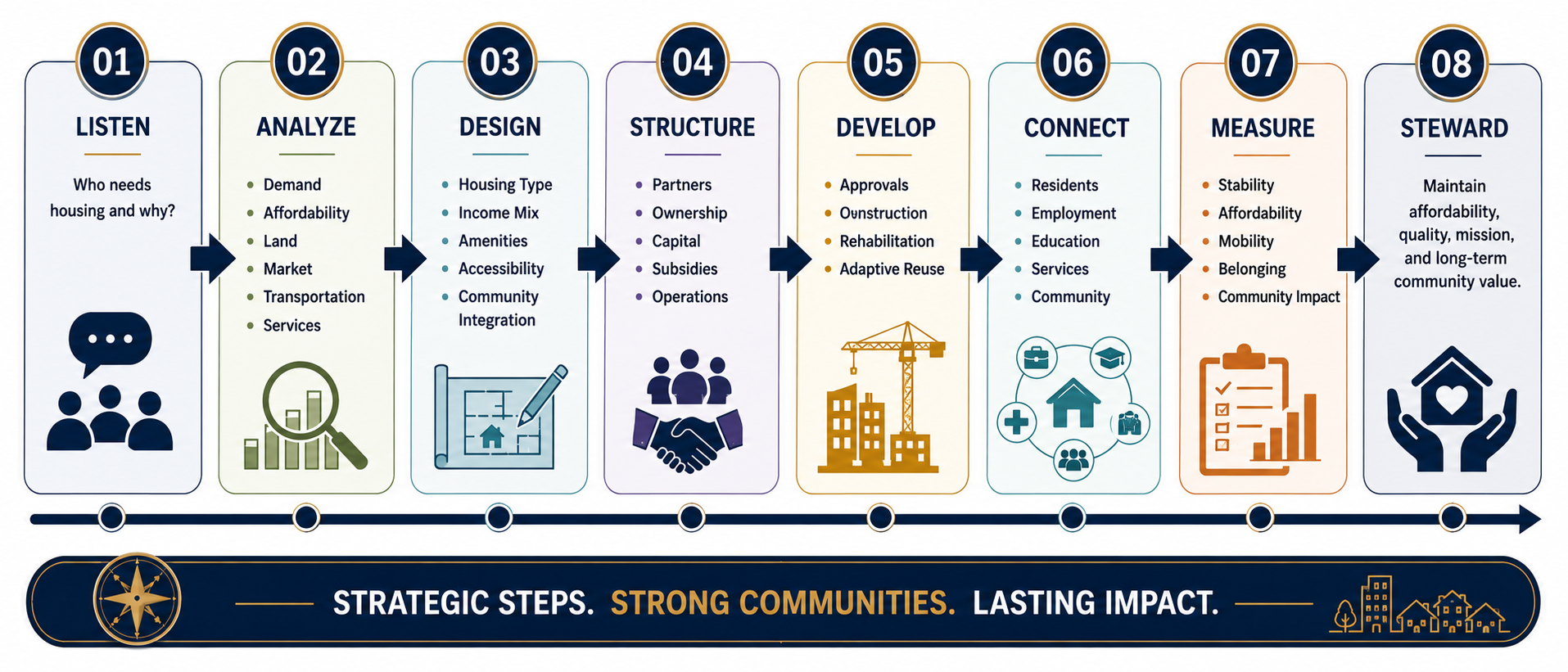
THE PARTNERSHIP TABLE
No Single Organization Solves Housing.
The Military Brat Housing Initiative™ function through partnerships appropriate to each project.
Potential participants include:
Cities & Counties
Planning • Land • Infrastructure • Housing policy
Housing Authorities
Local housing expertise • Programs • Qualified development partnerships
Developers
Predevelopment • Construction • Delivery
Financial Institutions
Qualified financing • Community investment
Philanthropy
Catalytic capital • Predevelopment • Community initiatives
Employers
Workforce demand • Employer-assisted housing strategies
Universities
Land • Research • Student/employee housing • Partnerships
Community Organizations
Resident engagement • Services • Local knowledge
Brat Corps® CDC
Project coordination • Development strategy • Partnerships • Stewardship, as applicable
The initiative becomes the organizing framework, rather than pretending one organization can perform every role.
HOUSING CAPITAL
Governing Principle
Financially Sustainable.
Mission Accountable.
Both matter.
Match the Capital to the Mission.
Different housing models require different financing structures.
Potential project resources, subject to eligibility and availability, can include:
Private equity
Conventional debt
Public housing resources
Affordable-housing programs
Tax-credit structures
Local and state incentives
Philanthropic grants
Impact capital
Employer participation
Land contributions
Institutional partnerships
Community development financing
Resident revenues
The correct capital structure depends upon the project.
THE HOUSING IMPACT FRAMEWORK™
HOUSING STABILITY
Retention • Housing security • Residential continuity
AFFORDABILITY
Housing cost burden • Attainability • Income alignment
ECONOMIC MOBILITY
Employment • Income • Ownership • Asset building
COMMUNITY CONNECTION
Belonging • Participation • Social relationships • Volunteerism
ACCESS TO OPPORTUNITY
Education • Workforce • Transportation • Services
QUALITY & LONGEVITY
Property condition • Accessibility • Resident experience • Long-term sustainability
These measures can ultimately feed the larger:
Destination Index™
HOW HOUSING FITS WITHIN MCD
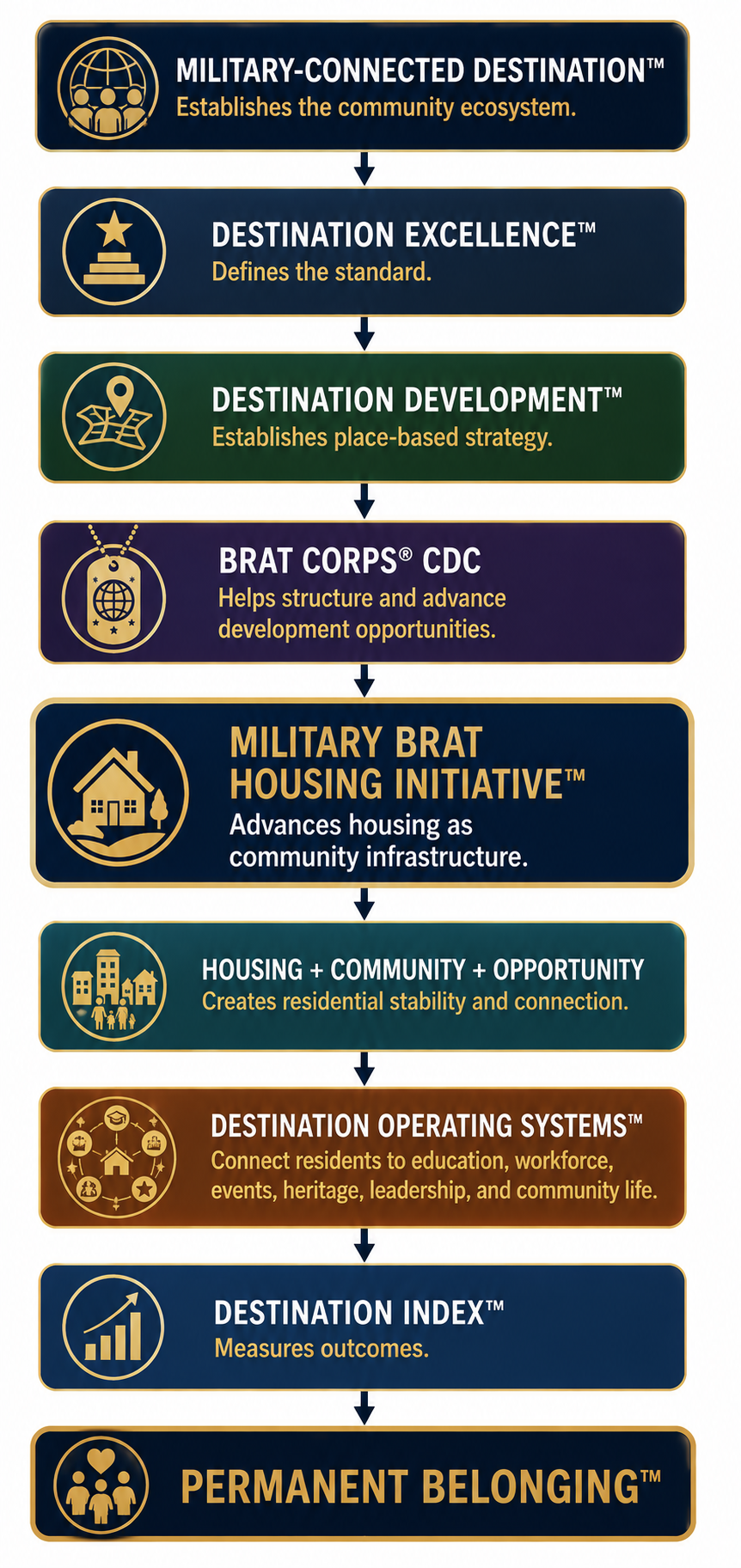
THE BELONGING TEST™
When evaluating a proposed housing project, we ask:
Is the housing safe and high quality?
Can intended residents reasonably afford it?
Is it connected to employment and education?
Can residents reach essential services?
Does the design encourage community without sacrificing privacy?
Can people with disabilities participate fully?
Are different generations considered?
Does the project strengthen rather than displace the surrounding community?
Is there a credible long-term operating model?
And finally:
Will Someone Living Here Feel That They Have Somewhere to Belong?
If we cannot answer that question, we have built housing.
We have not yet built home.
Find Your Place. Build Your Future.™
The Military Brat Housing Initiative™ begins with a simple proposition:
People need more than somewhere to sleep.
They need stability.
Opportunity.
Connection.
Community.
And the ability to imagine a future rooted somewhere by choice rather than determined by the next set of orders.
For generations raised learning how to leave, we can begin building places worth staying.
Explore Housing Opportunities
Develop With Us
Partner With the Initiative
Explore Brat Corps® CDC