DESTINATION INNOVATION™
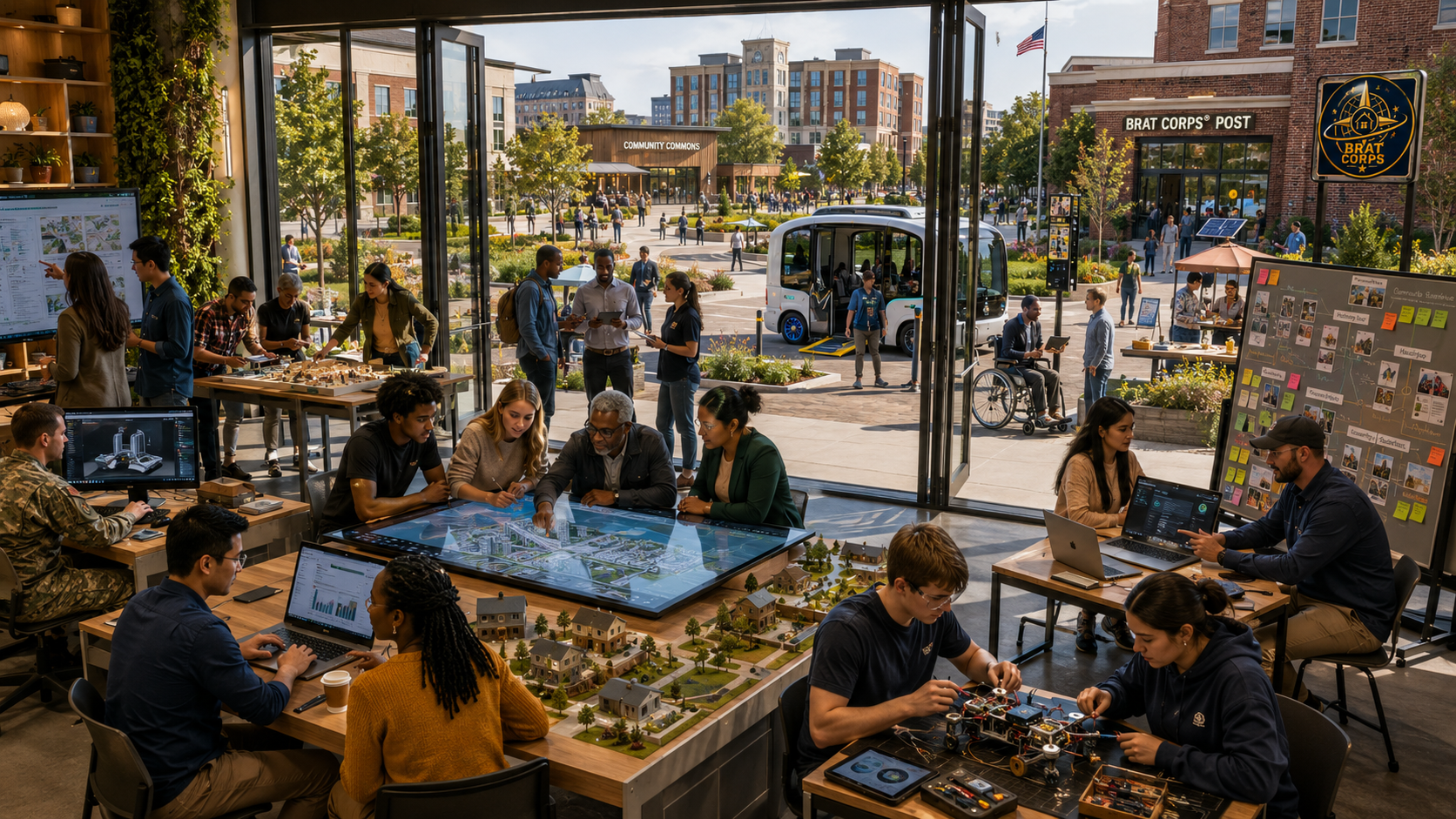
Building Communities Ready for What Comes Next.™
Destination Innovation™ is the future-readiness and applied innovation operating system of Military-Connected Destinations™.
Its purpose is not to make a destination look technologically advanced.
Its purpose is to create the permanent capacity to recognize change, solve emerging problems, test new approaches, learn from evidence, and move successful solutions into practice.
Don't Predict the Future. Build the Capacity to Meet It.™
Destination Innovation™
Building Communities Ready for What Comes Next.™
The future rarely arrives all at once.
It emerges through changing technologies, industries, demographics, workforce requirements, military missions, educational models, economic conditions, and community needs.
Communities cannot control every change they will encounter.
They can determine how prepared they are to respond.
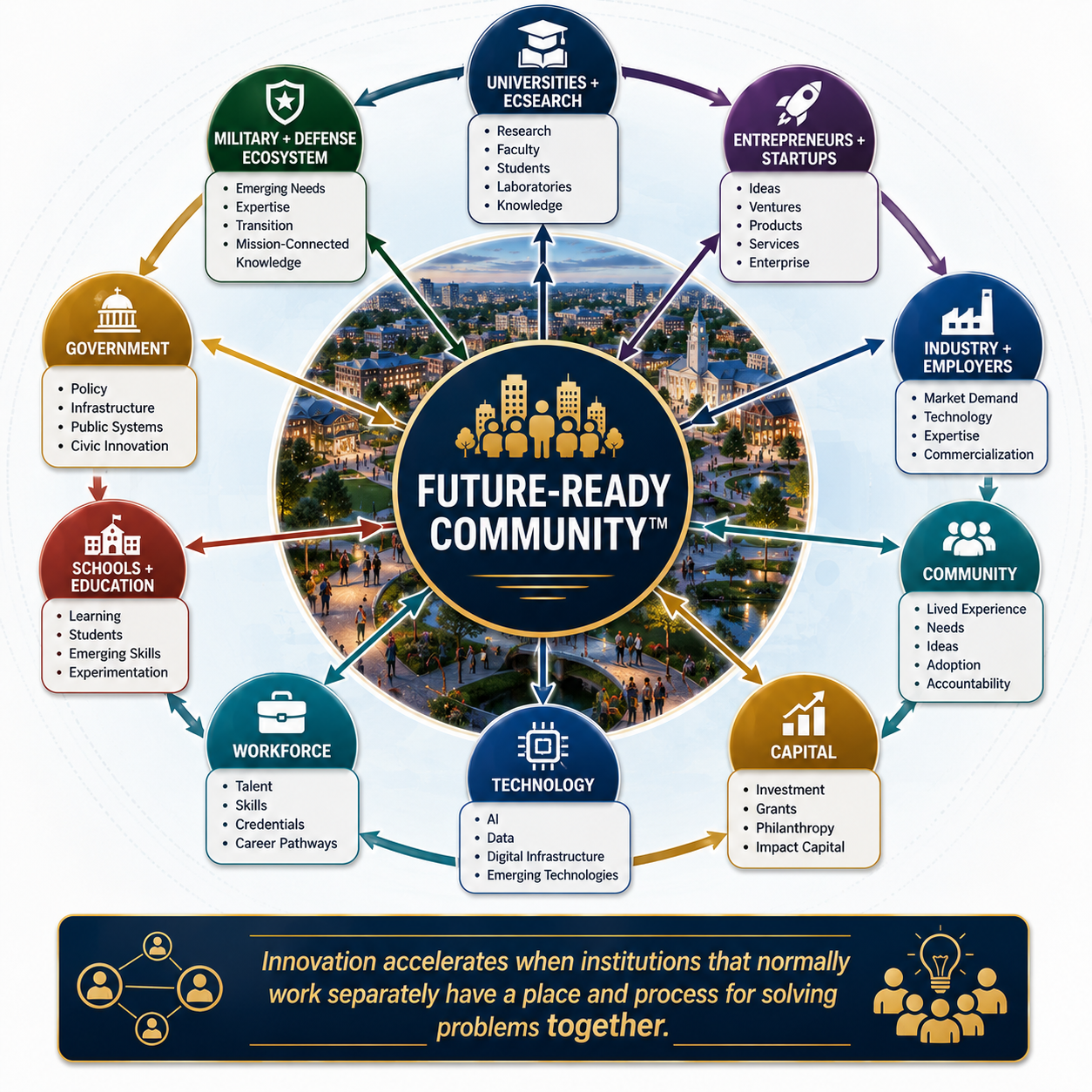
Destination Innovation™ connects residents, military-connected communities, universities, schools, government, employers, entrepreneurs, researchers, investors, and institutions to identify emerging challenges and opportunities—and turn them into practical solutions.
This is innovation with a destination purpose:
Understand what is changing.
Imagine what could work better.
Test responsibly.
Measure honestly.
Scale what works.
Defining Principle
Innovation Is Not Simply Inventing Something New.
It Is Increasing a Community's Capacity to Respond to What Changes Next.™
Explore the Innovation Model | Build With Us
INNOVATION WITH PURPOSE
New Is Not Enough.
Innovation is often associated with technology.
Artificial intelligence.
Startups.
Research laboratories.
New products.
Those matter, but they are only part of the picture.
A community can deploy new technology without solving an important problem.
It can build an innovation center without creating an innovation ecosystem.
It can launch dozens of pilots without institutionalizing anything that works.
Destination Innovation™ begins somewhere else:
What Problem Are We Trying to Solve?
Then:
Who experiences it?
Why does it exist?
What has already been tried?
What could work differently?
How would we know whether it worked?
What happens if it succeeds?
This makes innovation a discipline of community problem solving, not a collection of novelty projects.
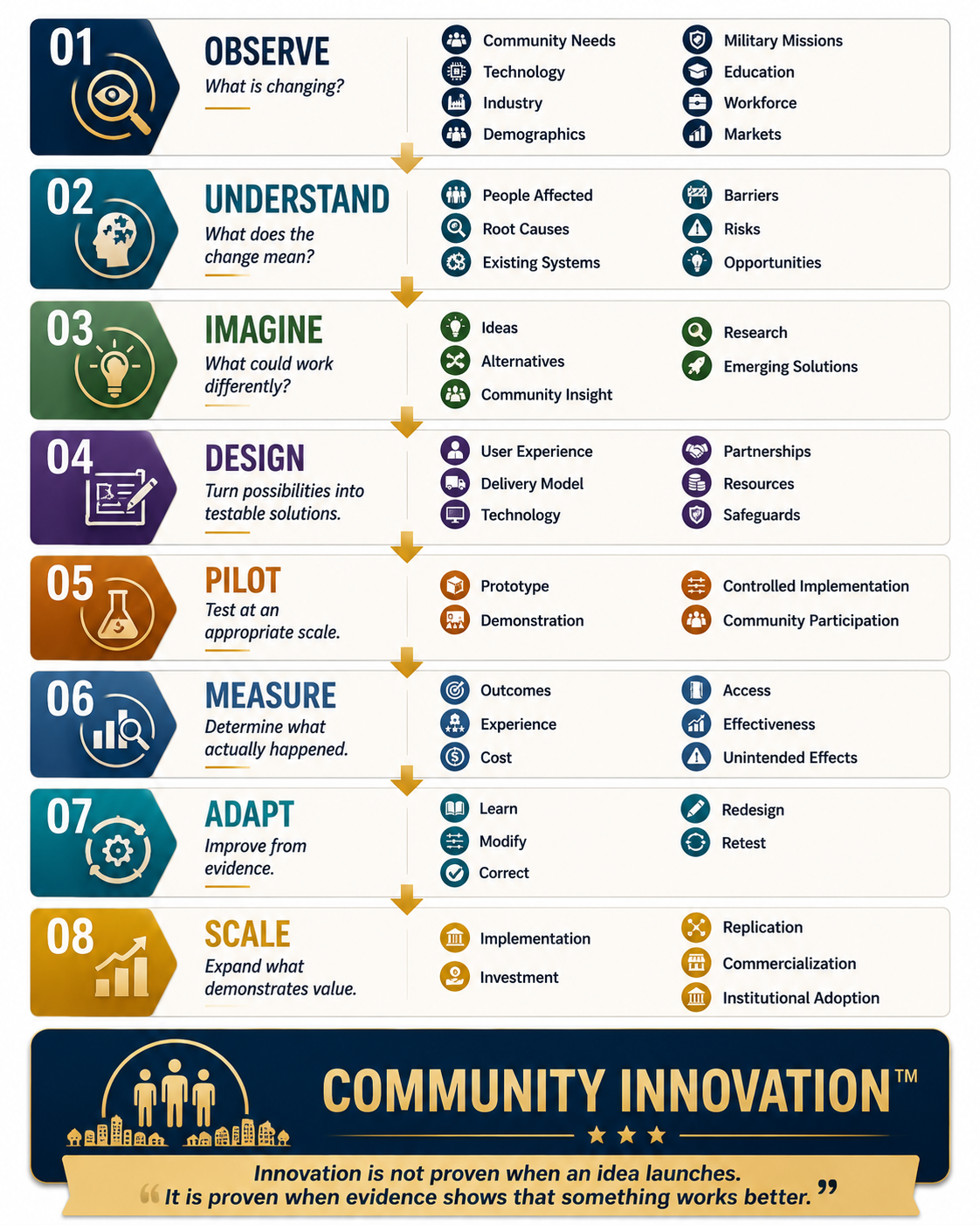
FROM PROBLEM TO POSSIBILITY™
THE DESTINATION INNOVATION ECOSYSTEM™
COMMUNITY AS A LIVING LABORATORY™
Test Solutions With Communities, not On Them.
A Military-Connected Destination™ can provide real-world environments in which appropriate solutions are:
co-designed;
piloted;
observed;
measured;
improved;
and, where successful,
scaled.
Potential areas could include:
housing;
transportation;
education;
workforce;
military-family transitions;
accessibility;
aging;
small-business development;
public spaces;
tourism;
community health;
energy;
digital services;
and civic participation.
But there must be a governing principle:
People Are Participants in Innovation, not Experimental Assets.™
Community innovation therefore incorporates appropriate safeguards involving:
privacy;
consent;
data governance;
accessibility;
ethics;
safety;
transparency;
community participation;
and accountability.
THE COMMUNITY INNOVATION LAB™
A Place for Problems Worth Solving.
Within participating destinations, the Community Innovation Lab™ provides the operating environment where cross-sector teams tackle specific destination challenges.
A challenge might enter the lab through:
residents;
schools;
local government;
employers;
military-connected communities;
universities;
nonprofits;
or destination institutions.
Then move through:
CHALLENGE
RESEARCH
CO-DESIGN
PROTOTYPE
PILOT
EVIDENCE
IMPLEMENTATION
The objective is not simply to produce ideas.
The Objective Is Implementation.™
THE INNOVATION DISTRICT™
Give Innovation a Physical Home.
Destination Development™ creates places.
Destination Innovation™ gives some of those places a future-facing function.
An Innovation District™ could connect:
Community Innovation Lab™
Innovation Hub™
university research presence
coworking
maker spaces
startup/incubator environments
workforce laboratories
training facilities
commercialization support
small-business space
Community Commons™
and nearby community institutions.
The Innovation District™ does not become an isolated technology campus.
Residents should move through it.
Students should learn there.
Entrepreneurs should build there.
Employers should recruit there.
Researchers should test ideas there.
Community organizations should participate there.
Innovation Belongs in the Community.™
FROM INNOVATION TO PROSPERITY™
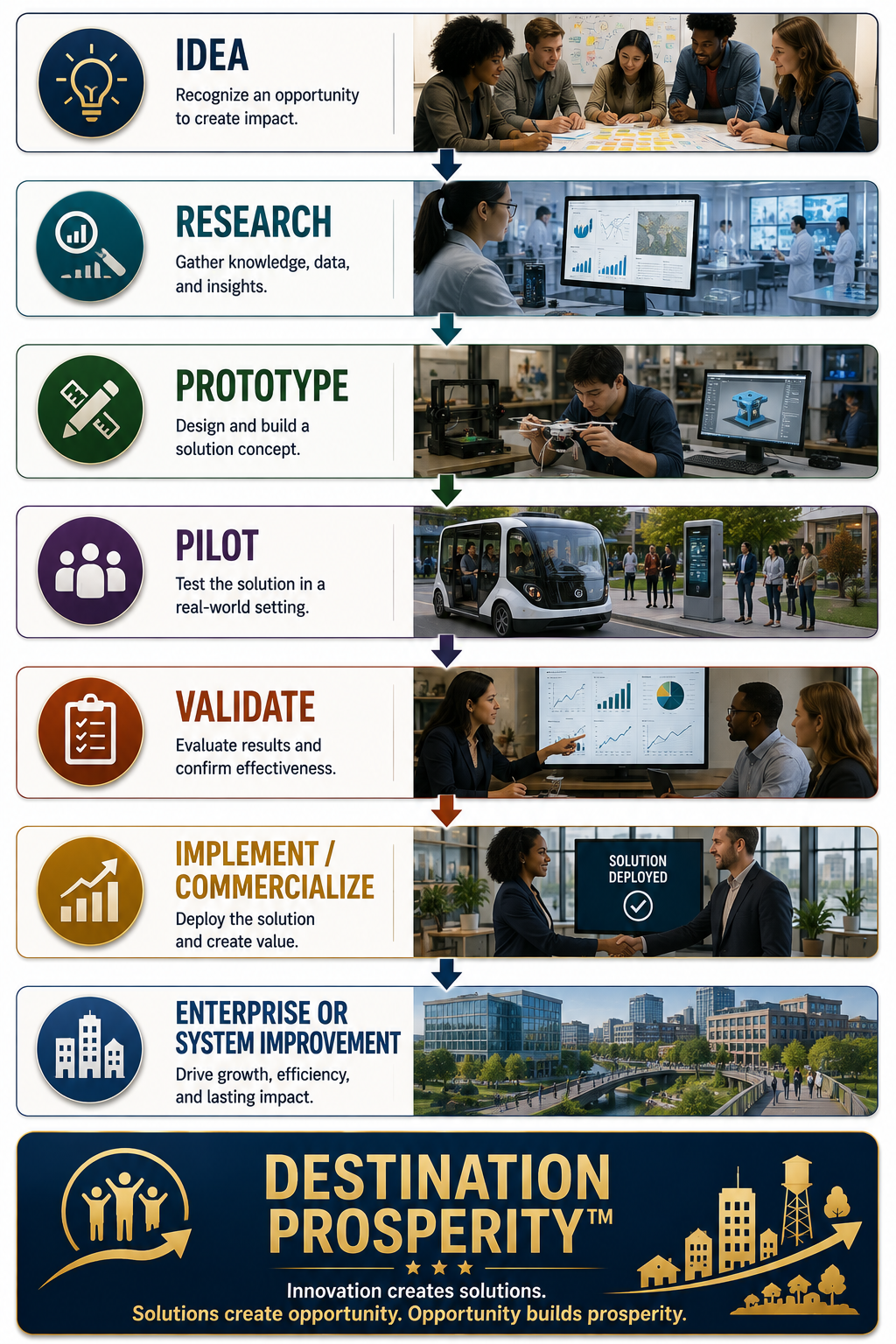
Not every innovation needs to become a company.
Some innovations become:
better public services;
new educational approaches;
improved nonprofit systems;
new policies;
intellectual property;
products;
businesses;
or better ways of delivering existing services.
And sometimes a pilot proves that an idea should not be scaled.
THE INNOVATION PORTFOLIO™
Don't Bet the Destination on One Big Idea.
A disciplined innovation system manages multiple ideas at different stages.
EXPLORE
Early concepts and emerging opportunities.
PILOT
Solutions being tested.
VALIDATE
Evidence being gathered.
SCALE
Demonstrated solutions expanding.
INSTITUTIONALIZE
Successful approaches becoming part of normal operations.
And importantly:
RETIRE
Ideas that do not demonstrate sufficient value are stopped, redesigned, or replaced.
An innovation system that cannot stop unsuccessful projects eventually becomes a project preservation system rather than an innovation system.
Test Small. Learn Fast. Scale Evidence.™
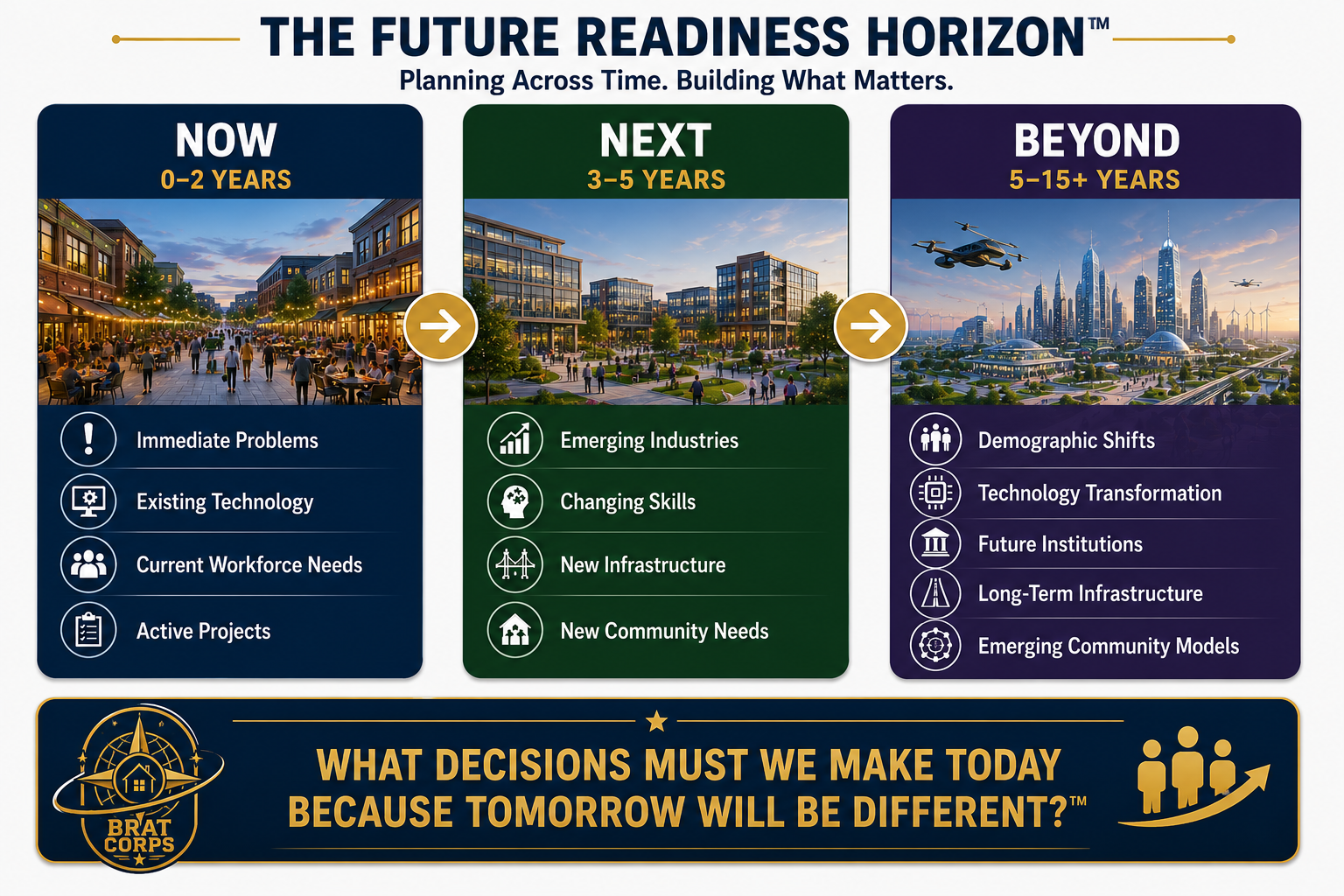
What Must This Community Be Ready for Next?
Destination Innovation™ continuously examine changes that may affect participating communities.
Potential areas include:
EMERGING INDUSTRIES
Where is economic opportunity moving?
ARTIFICIAL INTELLIGENCE + AUTOMATION
How will jobs, education, business, government, and community services change?
FUTURE OF WORK
Which roles, skills, credentials, and working arrangements are emerging?
DEMOGRAPHIC CHANGE
Who will live in the destination in 10, 20, or 30 years?
MILITARY TRANSFORMATION
How might changing missions, installations, technology, and force structure affect communities?
EDUCATION
How must learning evolve?
MOBILITY
How will people move through communities?
DIGITAL INFRASTRUCTURE
What connectivity will residents and institutions require?
RESILIENCE
How prepared are physical, economic, and institutional systems for disruption?
The objective is not prediction.
It is preparedness.
FUTURE READINESS™
THE FUTURE READINESS HORIZON™
What Decisions Must We Make Today Because Tomorrow Will Be Different?™
INNOVATION + EDUCATION
Destination Innovation™ connect deeply with the future Destination Education™ operating system.
Schools and universities are not merely places where people learn about innovation.
They can participate in it.
Students can:
research community problems;
develop prototypes;
conduct surveys;
analyze data;
work with employers;
participate in design challenges;
and test solutions.
Universities can contribute:
faculty expertise;
research;
laboratories;
students;
technology transfer;
evaluation;
and commercialization.
This creates:
COMMUNITY PROBLEM
LEARNING EXPERIENCE
RESEARCH
SOLUTION
COMMUNITY VALUE™
Education becomes part of the destination's problem-solving infrastructure.
INNOVATION + WORKFORCE
Destination Innovation™ also anticipate the skills the destination will require before shortages become crises.
This is where the future Destination Workforce™ system connects.
EMERGING TECHNOLOGY
CHANGING INDUSTRY
NEW SKILL REQUIREMENTS
EDUCATION + TRAINING RESPONSE
TALENT DEVELOPMENT
FUTURE-READY WORKFORCE™
Innovation therefore informs workforce strategy.
Workforce capacity, in turn, determines whether innovation can actually be implemented.
INNOVATION + DESTINATION DEVELOPMENT™
Innovation needs physical infrastructure.
Destination Development™ can support environments such as:
innovation districts;
research facilities;
maker spaces;
demonstration sites;
flexible commercial space;
training centers;
digital infrastructure;
coworking;
adaptive-reuse innovation facilities;
and public spaces capable of supporting experimentation and community engagement.
The relationship is simple:
Destination Development™ builds the environment.
Destination Innovation™ creates the innovation function.
DATA AS COMMUNITY INFRASTRUCTURE™
Better Decisions Require Better Information.
Destination Innovation™ encourages destinations to build responsible data capacity.
This could include:
community indicators;
economic data;
housing data;
workforce information;
visitor data;
education outcomes;
program performance;
resident experience;
and destination metrics.
But data must be governed.
Principles should include:
Purpose
Collect information for a legitimate reason.
Proportionality
Do not collect more than necessary.
Privacy
Protect individuals.
Security
Protect systems and information.
Transparency
Explain how information is used.
Accountability
Establish responsibility.
Utility
Collect data that can actually inform decisions.
This connects directly to the future Destination Index™.
THE INNOVATION CHALLENGE™
Destination Innovation™ could establish recurring destination challenges around real problems.
For example:
HOUSING CHALLENGE
How can attainable housing be expanded?
MOBILITY CHALLENGE
How can residents reach jobs and services more effectively?
MILITARY TRANSITION CHALLENGE
How can PCS transitions become less disruptive?
AGING + ACCESSIBILITY CHALLENGE
How can communities support lifelong belonging?
SMALL-BUSINESS CHALLENGE
How can local enterprises access more destination spending?
EDUCATION CHALLENGE
How can learning connect more directly to opportunity?
Teams could include residents, students, researchers, businesses, government, military-connected representatives, and institutions.
Winning should not mean receiving a trophy.
Winning should mean earning an opportunity to pilot the solution.
INNOVATION GOVERNANCE™
Innovation Needs Guardrails.
Not every innovation should be deployed simply because it is possible.
Destination Innovation™ establish appropriate governance around:
ethics;
privacy;
security;
accessibility;
community impact;
procurement;
conflicts of interest;
intellectual property;
data;
risk;
evaluation;
and accountability.
Particularly where AI, health, children, personal data, surveillance-capable technologies, or vulnerable populations are involved, governance must precede experimentation.
Governing Principle: “Responsible Innovation Is Better Innovation. ™”
THE DESTINATION INNOVATION INDEX™
Innovation capacity should ultimately become measurable within the larger Destination Index™.
We recommend measurement across six domains:
READINESS
Ability to recognize emerging change.
COLLABORATION
Cross-sector participation in innovation.
EXPERIMENTATION
Number and quality of appropriate pilots.
EVIDENCE
Use of measurement and evaluation.
IMPLEMENTATION
Rate at which demonstrated solutions move into practice.
IMPACT
Measurable community, institutional, or economic improvement.
Additional indicators could examine:
research partnerships;
student participation;
entrepreneurship;
capital attracted;
commercialization;
community participation;
and replication.
Again, we do not reward a destination merely for having many pilots.
The important measure is:
Did Innovation Improve Anything?
THE INNOVATION TEST™
Before calling something innovation, ask:
What problem are we solving?
Who experiences that problem?
Were those people involved in designing the solution?
What evidence supports the approach?
Can it be tested responsibly?
How will success be measured?
What are the risks?
What happens to the data?
Can the solution be improved?
Can it scale?
Who will own or operate it afterward?
And finally:
If It Works, Can the Community Actually Use It?
A prototype sitting in a laboratory does not transform a destination.
Implementation does.
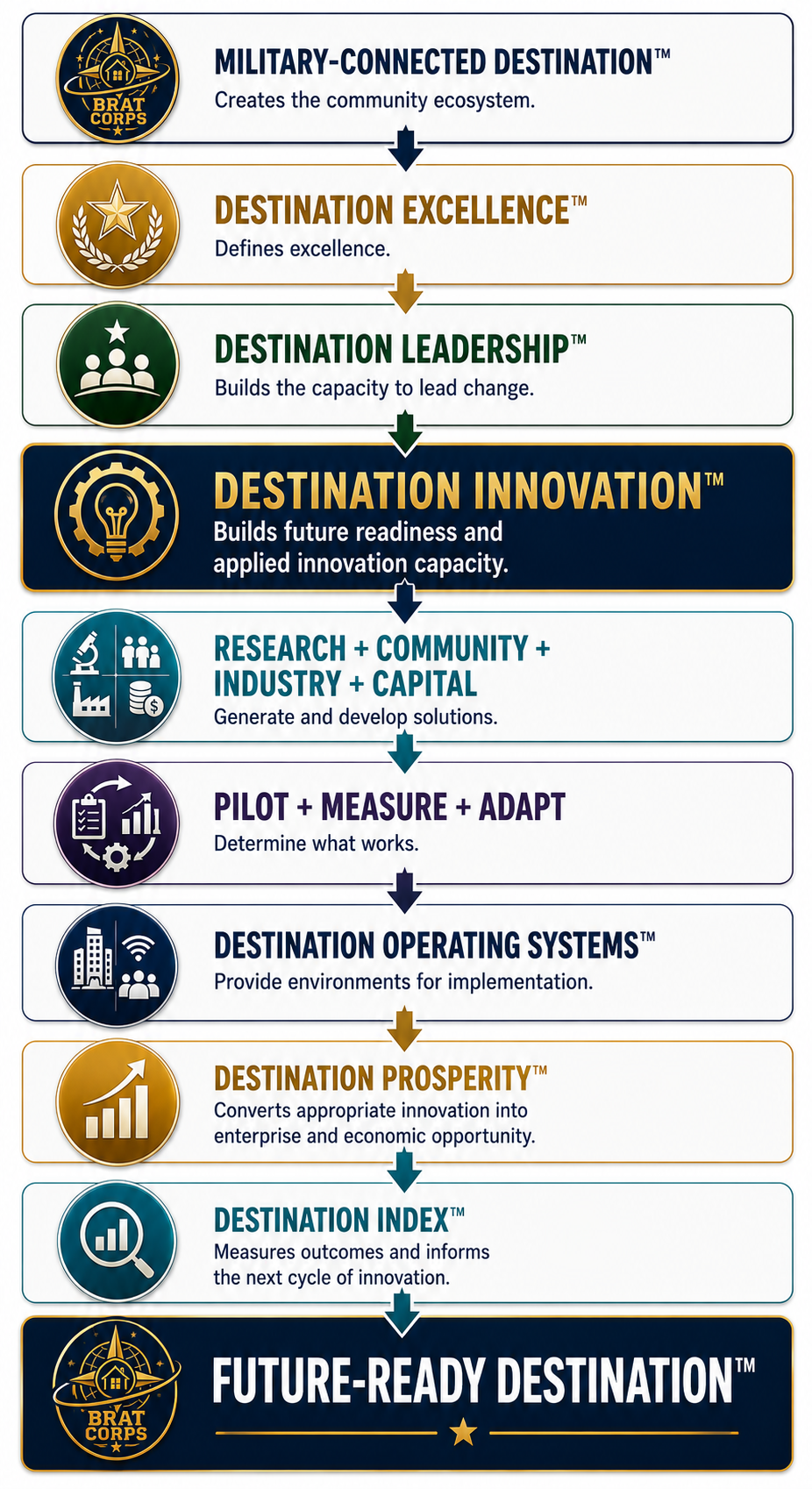
HOW DESTINATION INNOVATION™ FITS WITHIN MCD
Don't Predict the Future. Build the Capacity to Meet It.™
A future-ready destination does not need to know exactly what comes next.
It needs the capacity to recognize change.
Ask better questions.
Bring the right people together.
Generate possibilities.
Test responsibly.
Measure honestly.
Abandon what does not work.
Scale what does.
And continuously learn.
That is Destination Innovation™.
Bring Us a Challenge | Pilot a Solution | Partner With Destination Innovation™
A prototype sitting in a laboratory does not transform a destination.
Implementation does.