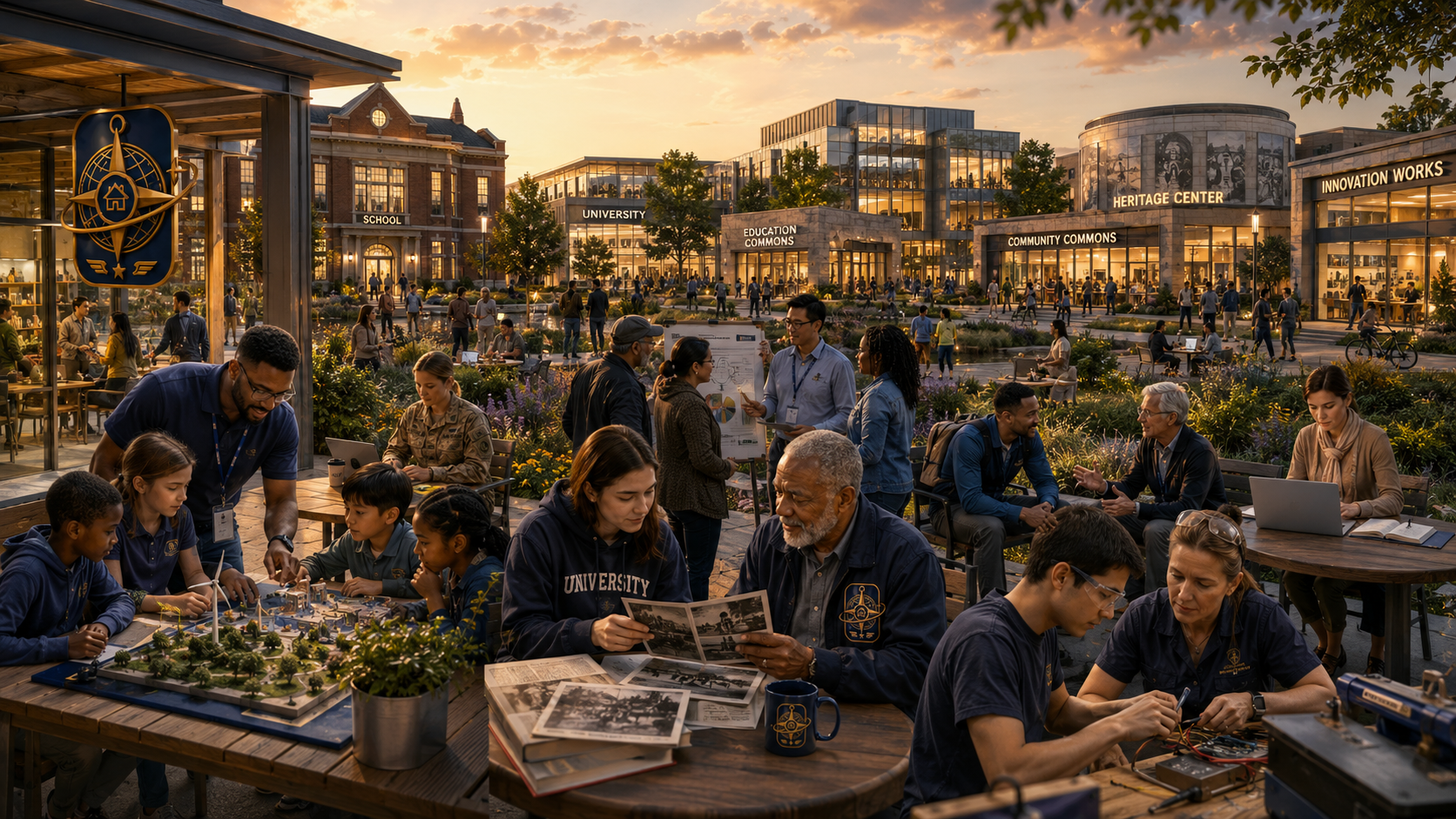
DESTINATION EDUCATION™
How Do Communities Develop Human Potential? ™
A Military-Connected Destination™ cannot achieve lasting excellence by focusing only on where people live, work, gather, or visit.
It must also build the conditions in which people can learn, develop, adapt, contribute, and continue growing throughout life.
Destination Education™ is the lifelong learning system of the Military-Connected Destination™.
It connects early learning, K–12 education, higher education, career and technical education, continuing education, research, families, employers, community institutions, and experiential learning into a coordinated ecosystem of human development.
The objective extends beyond educational attainment.
EDUCATION BUILDS CAPACITY.
Capacity to understand.
Capacity to adapt.
Capacity to participate.
Capacity to lead.
Capacity to create.
Capacity to contribute.
A destination becomes stronger when learning is not confined to an institution, an age, or a classroom. ™
EDUCATION DOES NOT BEGIN OR END AT THE SCHOOLHOUSE DOOR
Schools remain essential.
But human development occurs throughout a community.
Children learn in classrooms.
Teenagers learn through projects, mentors, service, sports, arts, technology, and work experiences.
College students learn through universities, research, internships, and community engagement.
Adults acquire credentials, develop new capabilities, change careers, and return to education.
Entrepreneurs learn by building.
Professionals learn as industries evolve.
Older adults teach, mentor, study, and transfer knowledge.
Families shape learning long before and long after formal instruction.
Destination Education™ therefore treats the entire destination as a learning environment.
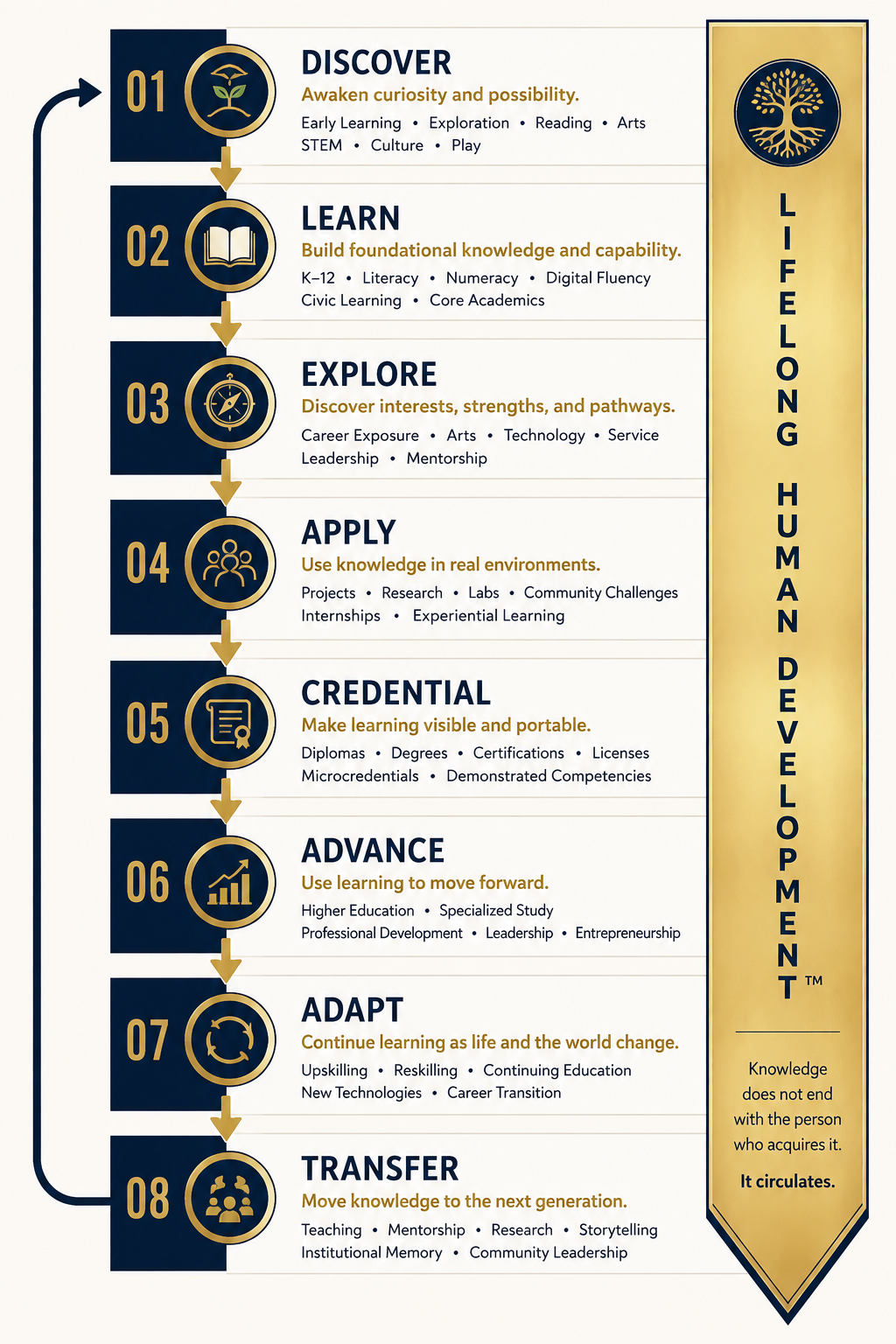
THE LIFELONG LEARNING CONTINUUM™
01 — DISCOVER
Awaken curiosity and possibility.
Early Learning • Exploration • Reading • Arts • STEM • Culture • Play
02 — LEARN
Build foundational knowledge and capability.
K–12 • Literacy • Numeracy • Digital Fluency • Civic Learning • Core Academics
03 — EXPLORE
Discover interests, strengths, and pathways.
Career Exposure • Arts • Technology • Service • Leadership • Mentorship
04 — APPLY
Use knowledge in real environments.
Projects • Research • Labs • Community Challenges • Internships • Experiential Learning
05 — CREDENTIAL
Make learning visible and portable.
Diplomas • Degrees • Certifications • Licenses • Microcredentials • Demonstrated Competencies
06 — ADVANCE
Use learning to move forward.
Higher Education • Specialized Study • Professional Development • Leadership • Entrepreneurship
07 — ADAPT
Continue learning as life and the world change.
Upskilling • Reskilling • Continuing Education • New Technologies • Career Transition
08 — TRANSFER
Move knowledge to the next generation.
Teaching • Mentorship • Research • Storytelling • Institutional Memory • Community Leadership
LIFELONG HUMAN DEVELOPMENT™
And TRANSFER reconnects to DISCOVER.
Knowledge does not end with the person who acquires it.
It circulates.
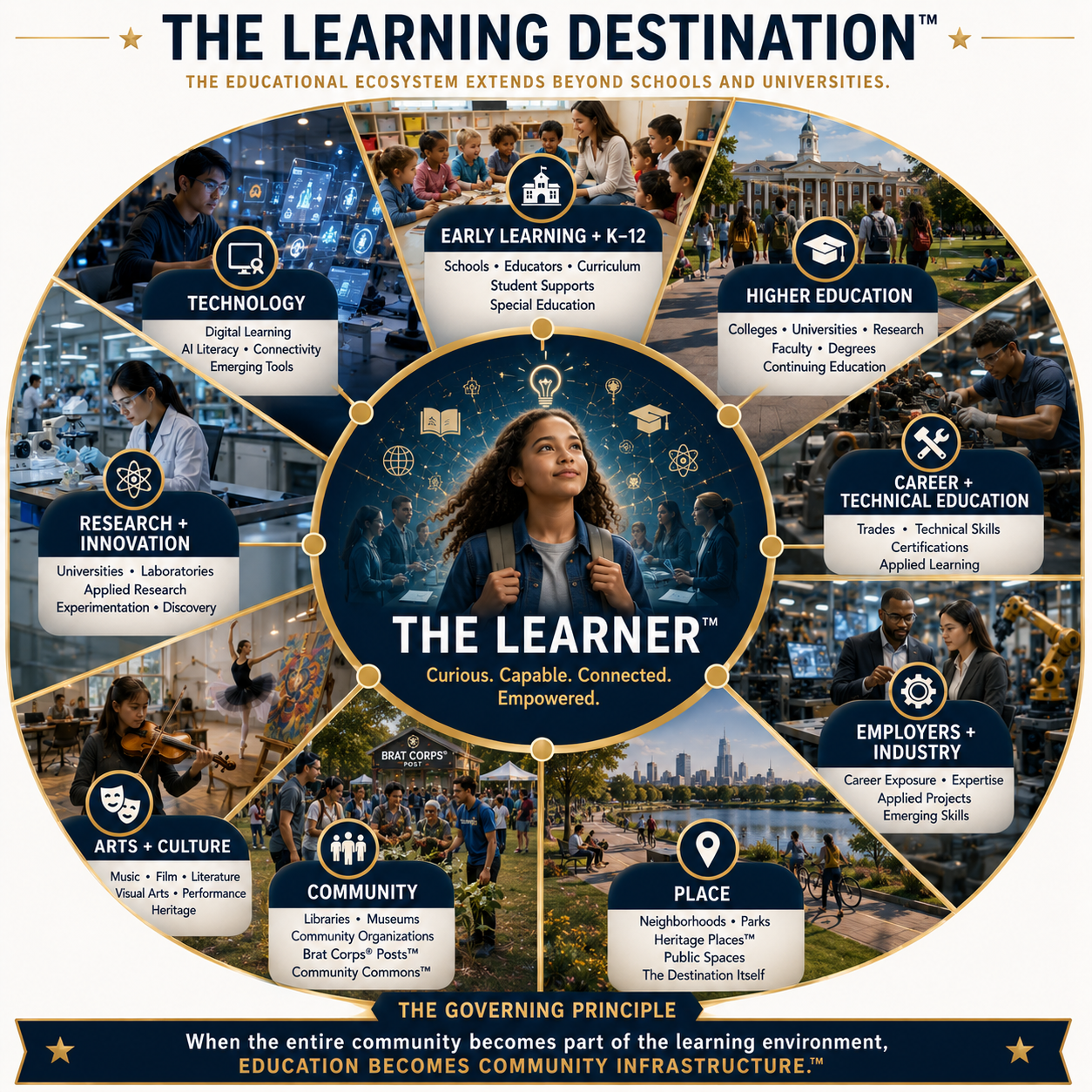
THE LEARNING DESTINATION™
The educational ecosystem extends beyond schools and universities.
At the center:
THE LEARNER™
EARLY LEARNING + K–12
Schools • Educators • Curriculum • Student Supports • Special Education
HIGHER EDUCATION
Colleges • Universities • Research • Faculty • Degrees • Continuing Education
CAREER + TECHNICAL EDUCATION
Trades • Technical Skills • Certifications • Applied Learning
FAMILIES
Parents • Caregivers • Stability • Advocacy • Learning Support
EMPLOYERS + INDUSTRY
Career Exposure • Expertise • Applied Projects • Emerging Skills
COMMUNITY
Libraries • Museums • Community Organizations • Brat Corps® Posts™ • Community Commons™
ARTS + CULTURE
Music • Film • Literature • Visual Arts • Performance • Heritage
RESEARCH + INNOVATION
Universities • Laboratories • Applied Research • Experimentation • Discovery
TECHNOLOGY
Digital Learning • AI Literacy • Connectivity • Emerging Tools
PLACE
Neighborhoods • Parks • Heritage Places™ • Public Spaces • The Destination Itself
The governing principle:
When the entire community becomes part of the learning environment, education becomes community infrastructure.
MILITARY-CONNECTED EDUCATIONAL CONTINUITY
Military-connected learners often experience educational transitions that conventional place-based systems were not designed around.
A student may leave one curriculum and enter another.
A family may cross state lines.
A child may move between public, private, charter, DoDEA, international, homeschool, or other educational environments.
Credits may not align.
Graduation requirements may change.
Services may be interrupted.
Athletic eligibility may change.
Advanced coursework may not transfer cleanly.
Special-education supports may require renewed coordination.
Friendships, mentors, teachers, activities, and familiar environments can disappear almost overnight.
Destination Education™ treats educational continuity as infrastructure.
The question is not simply:
“Does this community have good schools?”
It is:
“CAN A LEARNER ARRIVE, CONNECT, CONTINUE, AND ADVANCE?” ™
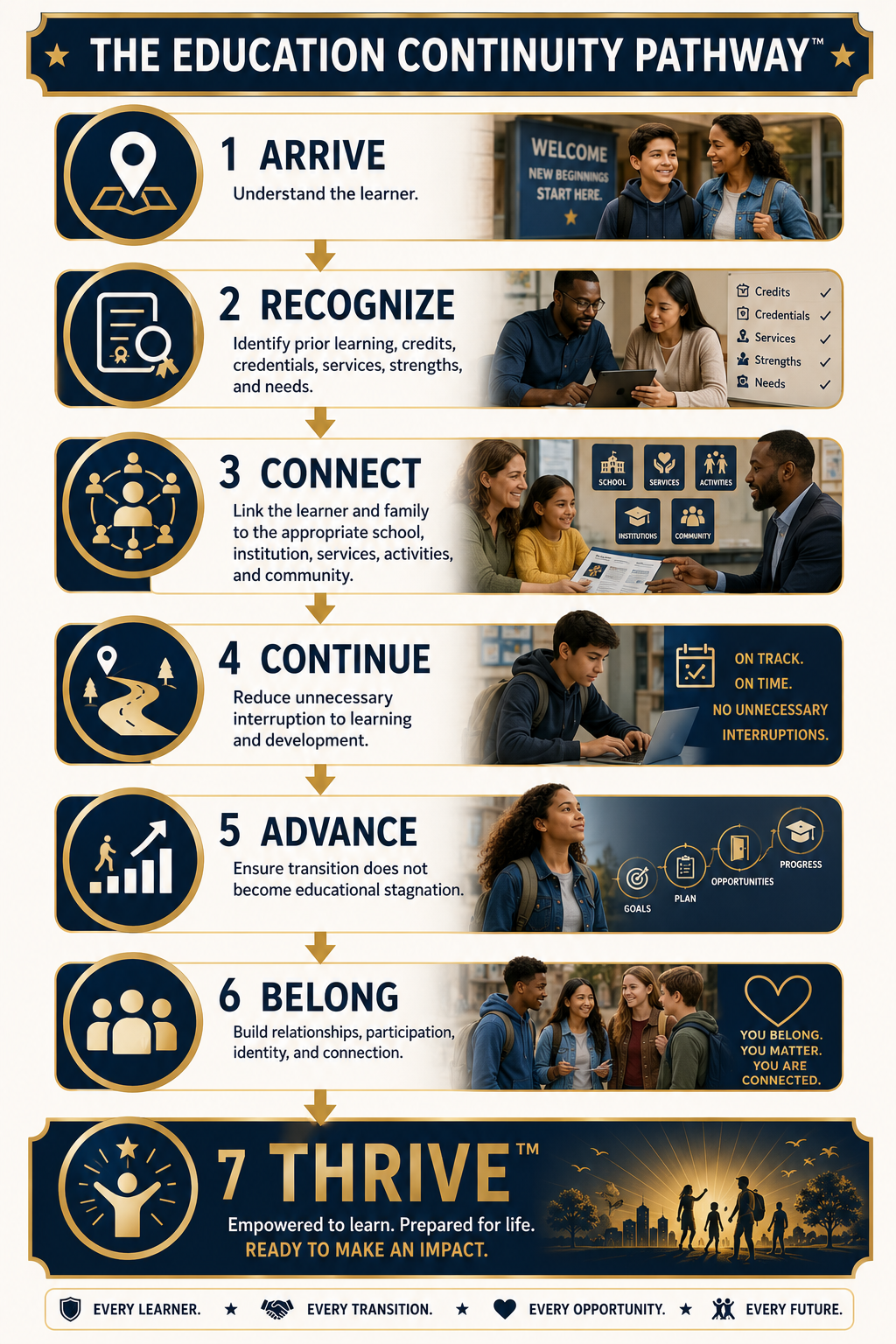
THE EDUCATION CONTINUITY PATHWAY™
THE EDUCATION CONTINUITY PATHWAY™
ARRIVE
Understand the learner.
RECOGNIZE
Identify prior learning, credits, credentials, services, strengths, and needs.
CONNECT
Link the learner and family to the appropriate school, institution, services, activities, and community.
CONTINUE
Reduce unnecessary interruption to learning and development.
ADVANCE
Ensure transition does not become educational stagnation.
BELONG
Build relationships, participation, identity, and connection.
THRIVE™
EDUCATIONAL MOBILITY™
Geographic mobility should not repeatedly erase educational progress.
Destination Education™ builds pathways for learning to travel with the learner.
That includes stronger recognition of:
Prior Learning
Credits
Credentials
Demonstrated Competencies
Projects
Certifications
Community Service
Leadership
Extracurricular Achievement
Work-Based Learning
Research
Portfolio Evidence
EDUCATION + FAMILY STABILITY
A strong educational system recognizes that learning conditions extend beyond the classroom.
Housing instability affects learning.
Transportation affects access.
Childcare affects families.
Health and behavioral health affect participation.
Food security affects readiness.
Digital access affects opportunity.
Frequent relocation affects continuity.
Community connection affects belonging.
Destination Education™ therefore connects education to the larger destination ecosystem rather than treating schools as isolated institutions.
THE CHILD DOES NOT ARRIVE AT SCHOOL WITHOUT THE REST OF THEIR LIFE.™
EDUCATION + PLACE
This is another important distinction in the MCD model.
The destination itself becomes educational.
A Heritage Center™ can become a classroom.
A local business can become a learning environment.
A university laboratory can become a pathway into research.
A Community Commons™ can host civic learning.
A Brat Corps® Post™ can support mentorship and intergenerational learning.
A park can become an environmental classroom.
A construction project can expose students to architecture, engineering, skilled trades, finance, and development.
A community challenge can become an applied-learning project.
Destination Education™ therefore asks:
WHAT CAN THIS PLACE TEACH?™
THE EDUCATION CONTINUITY PATHWAY™
THE EDUCATION CONTINUITY PATHWAY™
ARRIVE
Understand the learner.
RECOGNIZE
Identify prior learning, credits, credentials, services, strengths, and needs.
CONNECT
Link the learner and family to the appropriate school, institution, services, activities, and community.
CONTINUE
Reduce unnecessary interruption to learning and development.
ADVANCE
Ensure transition does not become educational stagnation.
BELONG
Build relationships, participation, identity, and connection.
THRIVE™
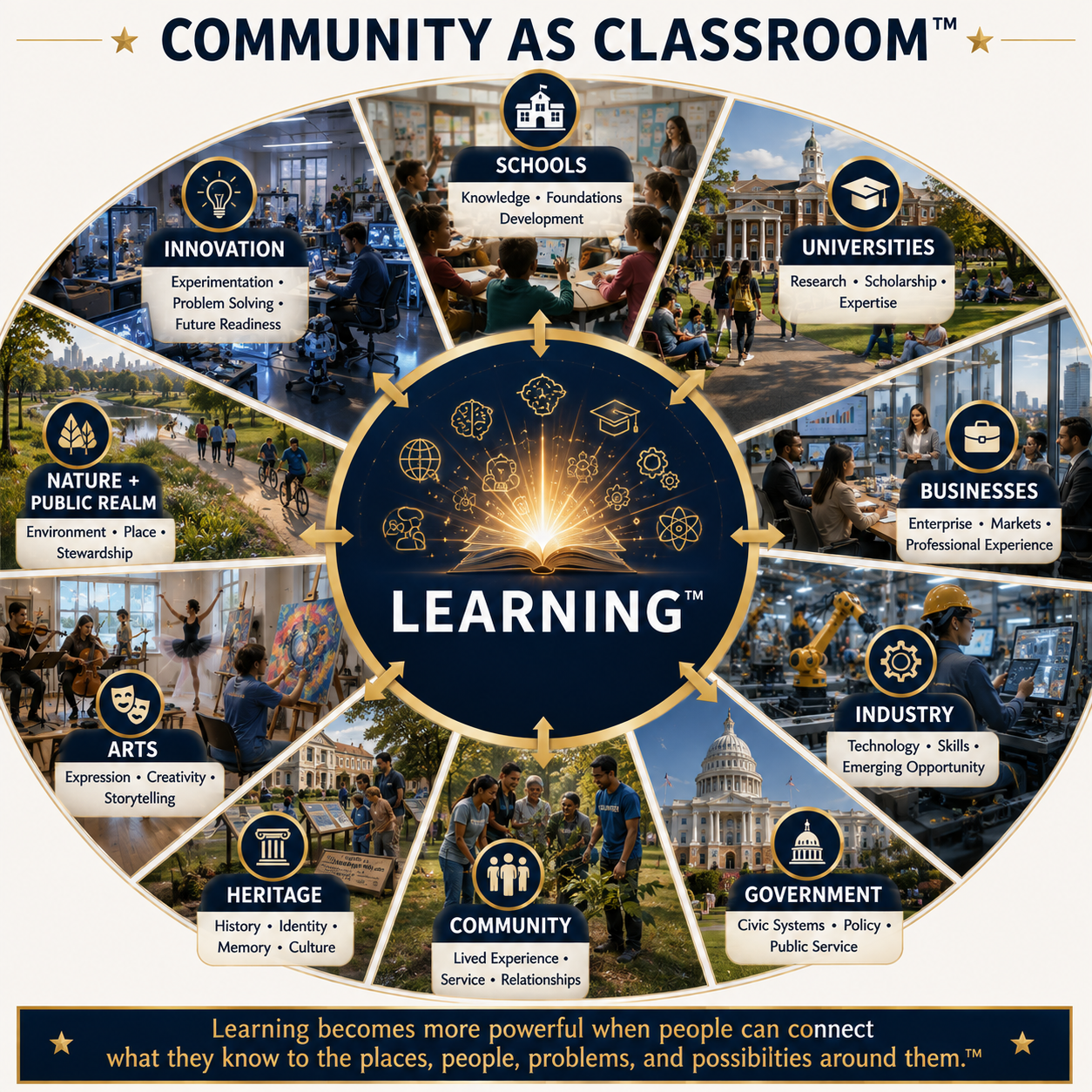
COMMUNITY AS CLASSROOM™
LEARNING™
SCHOOLS
Knowledge • Foundations • Development
UNIVERSITIES
Research • Scholarship • Expertise
BUSINESSES
Enterprise • Markets • Professional Experience
INDUSTRY
Technology • Skills • Emerging Opportunity
GOVERNMENT
Civic Systems • Policy • Public Service
COMMUNITY
Lived Experience • Service • Relationships
HERITAGE
History • Identity • Memory • Culture
ARTS
Expression • Creativity • Storytelling
NATURE + PUBLIC REALM
Environment • Place • Stewardship
INNOVATION
Experimentation • Problem Solving • Future Readiness
Learning becomes more powerful when people can connect what they know to the places, people, problems, and possibilities around them.™
FROM EDUCATION TO APPLICATION™
Education does not exist solely to produce workers.
But learning must be capable of becoming useful in life.
KNOWLEDGE
What do I understand?
CREDENTIAL
How is it recognized?
CAPABILITY
What can I do?
OPPORTUNITY
Where can it take me?
APPLICATION
Where can I use it?
CONTRIBUTION
What can I now create, solve, teach, or improve?
EXPERIENCE
What have I demonstrated?
HUMAN POTENTIAL™
RESEARCH UNIVERSITIES AS DESTINATION INSTITUTIONS
Universities are not simply educational providers within the MCD model.
They are anchor institutions.
They contribute:
Education
Research
Talent
Innovation
Cultural Programming
Community Engagement
Entrepreneurship
Economic Activity
Healthcare
Convening Power
Institutional Continuity
Destination Education™ creates pathways through which universities can engage the destination itself as a living environment for teaching, research, applied problem solving, and community partnership.
This connects directly to Destination Innovation™.
INTERGENERATIONAL LEARNING™
A Military-Connected Destination™ contains extraordinary, accumulated knowledge.
A teenager may understand emerging technology.
A mid-career professional may understand an industry.
A military spouse may understand mobility and adaptation.
A veteran may carry technical and leadership expertise.
A military brat may understand cross-cultural transition.
An educator may understand generations of military-connected students.
A senior military brat may carry memories that exist nowhere else.
Destination Education™ creates mechanisms for knowledge to move in every direction across generations.
Not simply:
OLD → YOUNG
But:
GENERATION ↔ GENERATION™
Teaching.
Mentorship.
Reverse mentorship.
Oral history.
Skills exchange.
Research.
Storytelling.
Community problem solving.
That connects Education directly to both Destination Leadership™ and Destination Legacy™.
EDUCATION COMMONS™
A connected environment where learners, educators, universities, employers, researchers, families, and community institutions can access:
Learning Opportunities
Tutoring • Mentorship
Credentials • Advising
Digital Learning
Career Exploration
Research
Projects
Community Education
Continuing Education
It does not replace schools or universities.
It connects them.
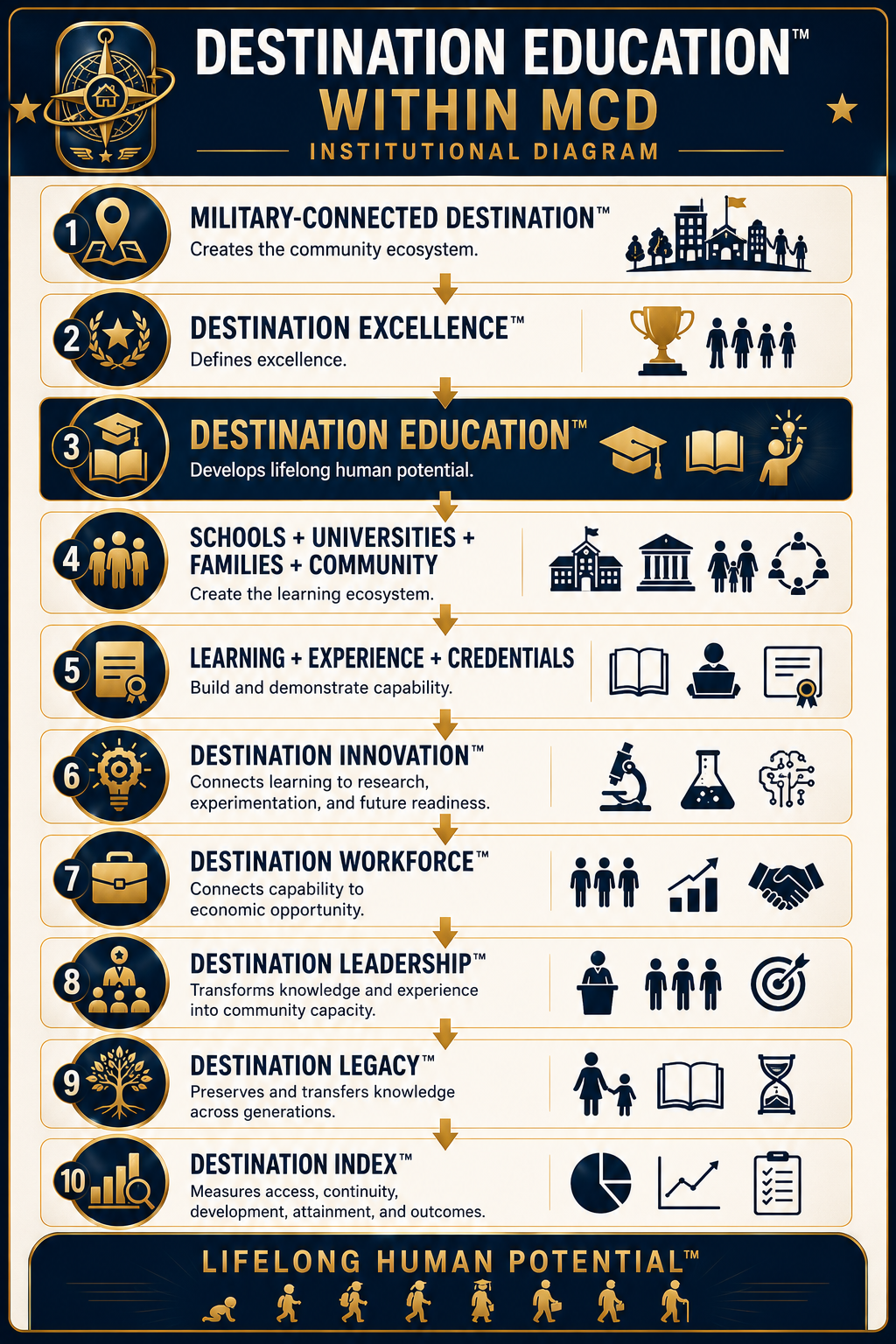
DESTINATION EDUCATION™ WITHIN MCD
MILITARY-CONNECTED DESTINATION™
Creates the community ecosystem.
Defines excellence.
Develops lifelong human potential.
SCHOOLS + UNIVERSITIES + FAMILIES + COMMUNITY
Create the learning ecosystem.
LEARNING + EXPERIENCE + CREDENTIALS
Build and demonstrate capability.
Connects learning to research, experimentation, and future readiness.
Connects capability to economic opportunity.
DESTINATION LEADERSHIP™
Transforms knowledge and experience into community capacity.
Preserves and transfers knowledge across generations.
DESTINATION INDEX™
Measures access, continuity, development, attainment, and outcomes.
LIFELONG HUMAN POTENTIAL™
HOW EDUCATIONAL EXCELLENCE IS MEASURED
Destination Index™ evaluates more than test scores or graduation rates.
ACCESS
Can learners reach high-quality educational opportunities?
CONTINUITY
Can learning continue through transition and mobility?
BELONGING
Are learners connected to their educational and community environments?
ATTAINMENT
Are learners completing meaningful educational milestones?
CAPABILITY
Are learners developing demonstrable knowledge and skills?
APPLICATION
Can learning be used in real environments?
MOBILITY
Can credentials and learning travel with the learner?
ADAPTABILITY
Can people continue learning as technology, careers, and life change?
TRANSFER
Is knowledge moving across generations and institutions?
The defining measurement question becomes: