DESTINATION LEGACY™
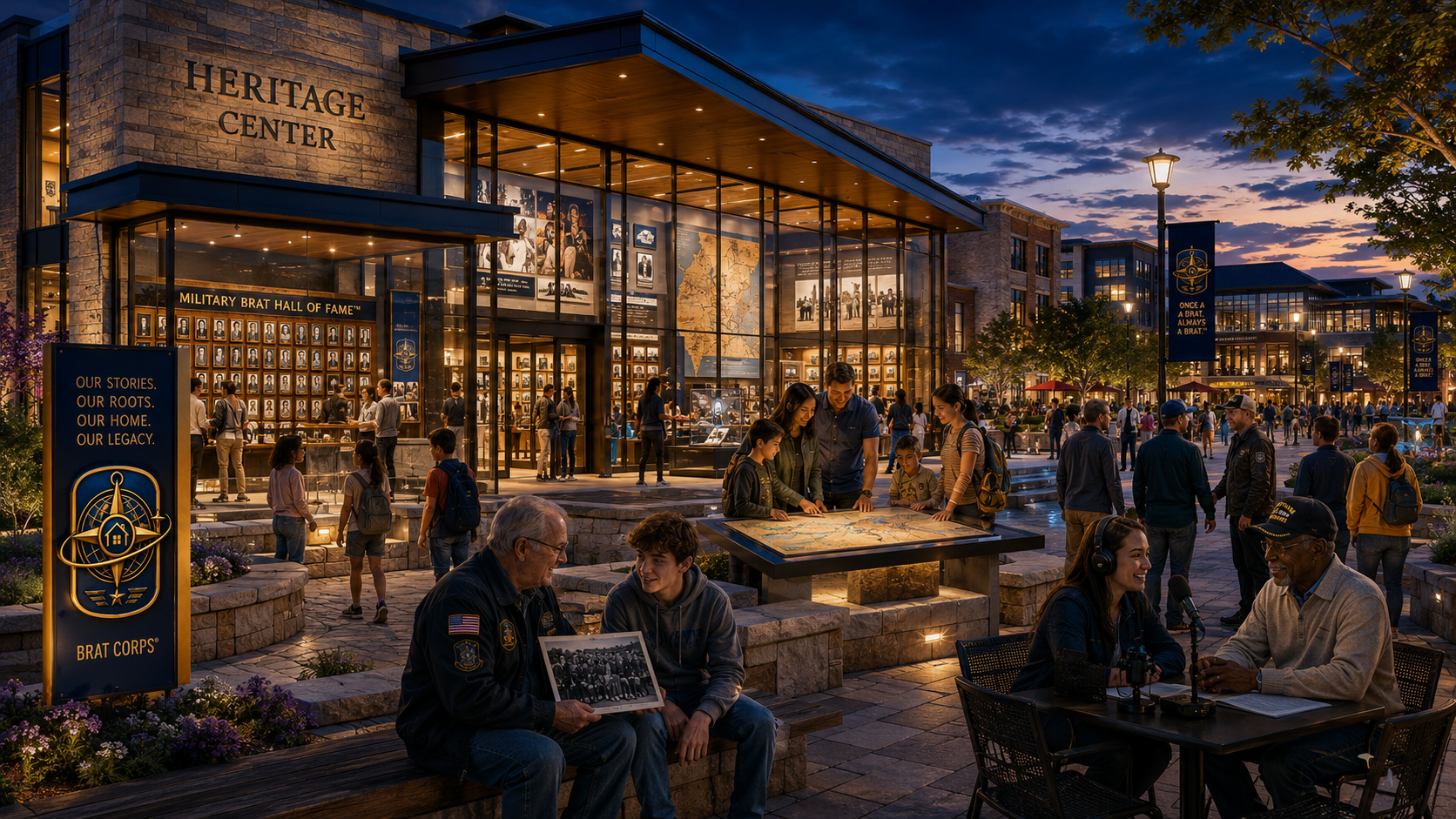
Preserving the Stories That Give a Community Its Identity. ™
Destination Legacy™ the memory, heritage, recognition, preservation, and intergenerational transmission operating system of a Military-Connected Destination™.
Buildings can be replaced. Leadership changes. Installations evolve. Families move. Institutions reorganize. But when the stories connecting people to those places disappear, communities lose something that cannot simply be reconstructed.
Destination Legacy™ exists to ensure that what a community has lived, learned, built, sacrificed, celebrated, and contributed is not lost—but carried forward.
Destination Legacy™
Preserving the Stories That Give a Community Its Identity. ™
Every destination inherits something.
Stories.
Places.
People.
Traditions.
Institutions.
Achievements.
Sacrifices.
Relationships.
Memories.
For military-connected communities, those histories are especially vulnerable to fragmentation. Families move. Generations disperse. Installations change. Schools close. Buildings disappear. Photographs remain in boxes. Yearbooks sit on shelves. Stories live in people's memories until there is no one left to tell them.
Destination Legacy™ creates the infrastructure through which a Military-Connected Destination™ identifies, captures, preserves, interprets, shares, honors, and transfers its military-connected heritage.
Not simply so the past can be remembered.
But so, it can continue to inform identity, strengthen belonging, educate future generations, create meaningful experiences, and shape what the community becomes next.
Defining Principle
A Community That Does Not Preserve Its Memory Eventually Loses Part of Its Identity.™
Explore Our Heritage | Share Your Story | Build a Legacy Destination
LEGACY IS COMMUNITY INFRASTRUCTURE
Heritage Is Not Decoration.
Heritage is sometimes treated as something a community addresses after its economic, educational, housing, infrastructure, and workforce priorities have been solved.
Destination Legacy™ rejects that assumption.
History influences identity.
Identity influences belonging.
Belonging influences participation.
Participation strengthens community.
And community helps sustain place.
Therefore:
MEMORY
IDENTITY
BELONGING
PARTICIPATION
STEWARDSHIP
COMMUNITY CONTINUITY™
Infrastructure helps people live somewhere. Memory helps people understand why that somewhere matters.™
01 — REMEMBER
Recognize what matters.
Stories
People
Places
Experiences
Traditions
Institutions
Milestones
02 — CAPTURE
Create the historical record.
Oral Histories
Documents
Photographs
Artifacts
Film + Audio
Digital Records
Personal Collections
03 — PRESERVE
Protect what has been entrusted to the future.
Archives
Collections
Heritage Places
Institutional Records
Digital Preservation
Conservation
04 — INTERPRET
Turn information into understanding.
Research
Exhibitions
Education
Storytelling
Scholarship
Public History
05 — SHARE
Return heritage to the community.
Heritage Week™
Heritage Center™
Schools
Digital Platforms
Public Programs
Community Experiences
06 — HONOR
Recognize people and contributions.
Military Brat Hall of Fame™
Recognition
Commemoration
Achievement
Service
07 — TRANSFER
Carry memory forward.
Children
Youth
Adults
Elders
Institutions
Future Generations
LIVING LEGACY™
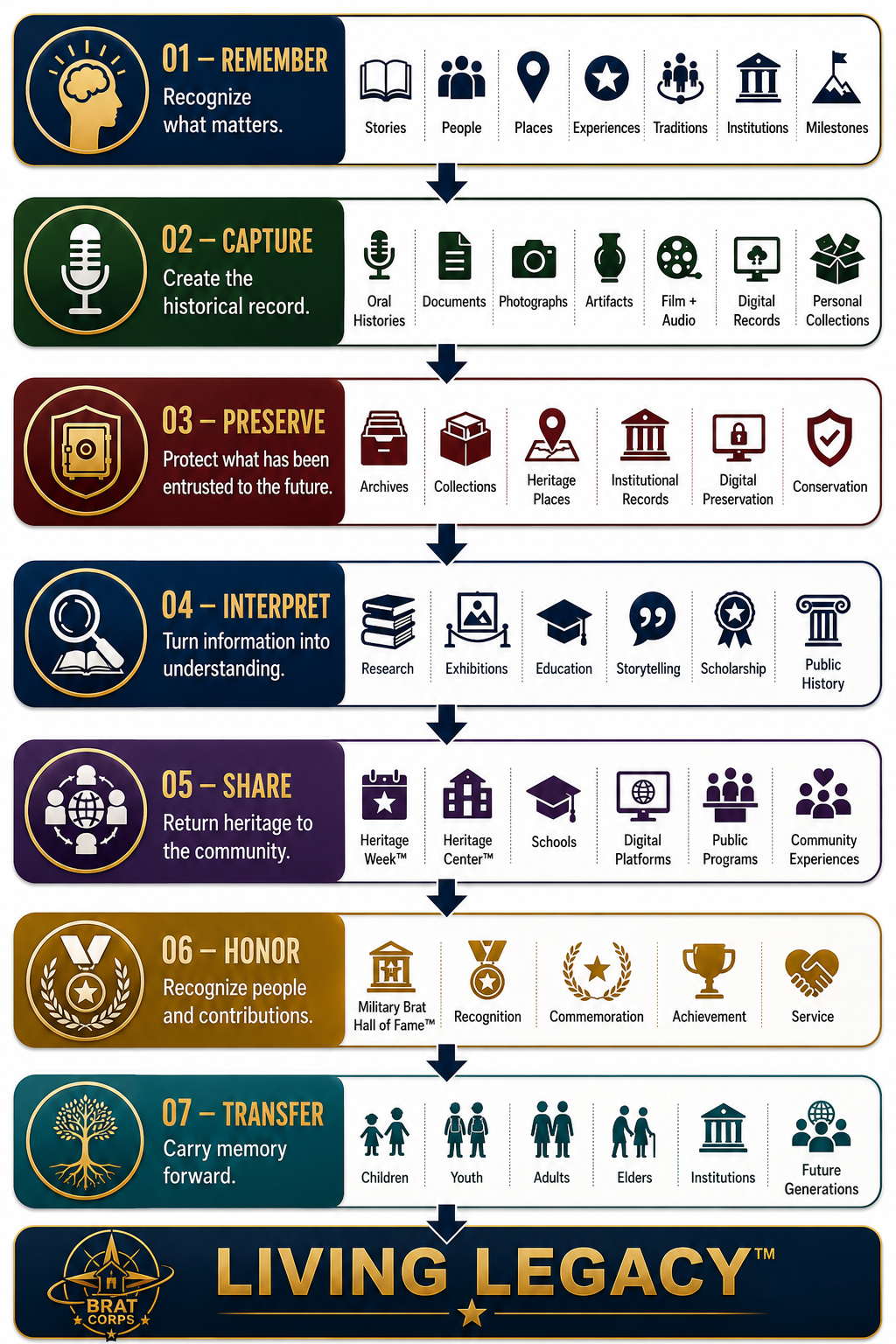
FROM MEMORY TO LIVING LEGACY™
Legacy is not what a community remembers after people are gone. Legacy is what a community intentionally carries forward while they are still here.™
THE DESTINATION LEGACY ECOSYSTEM™
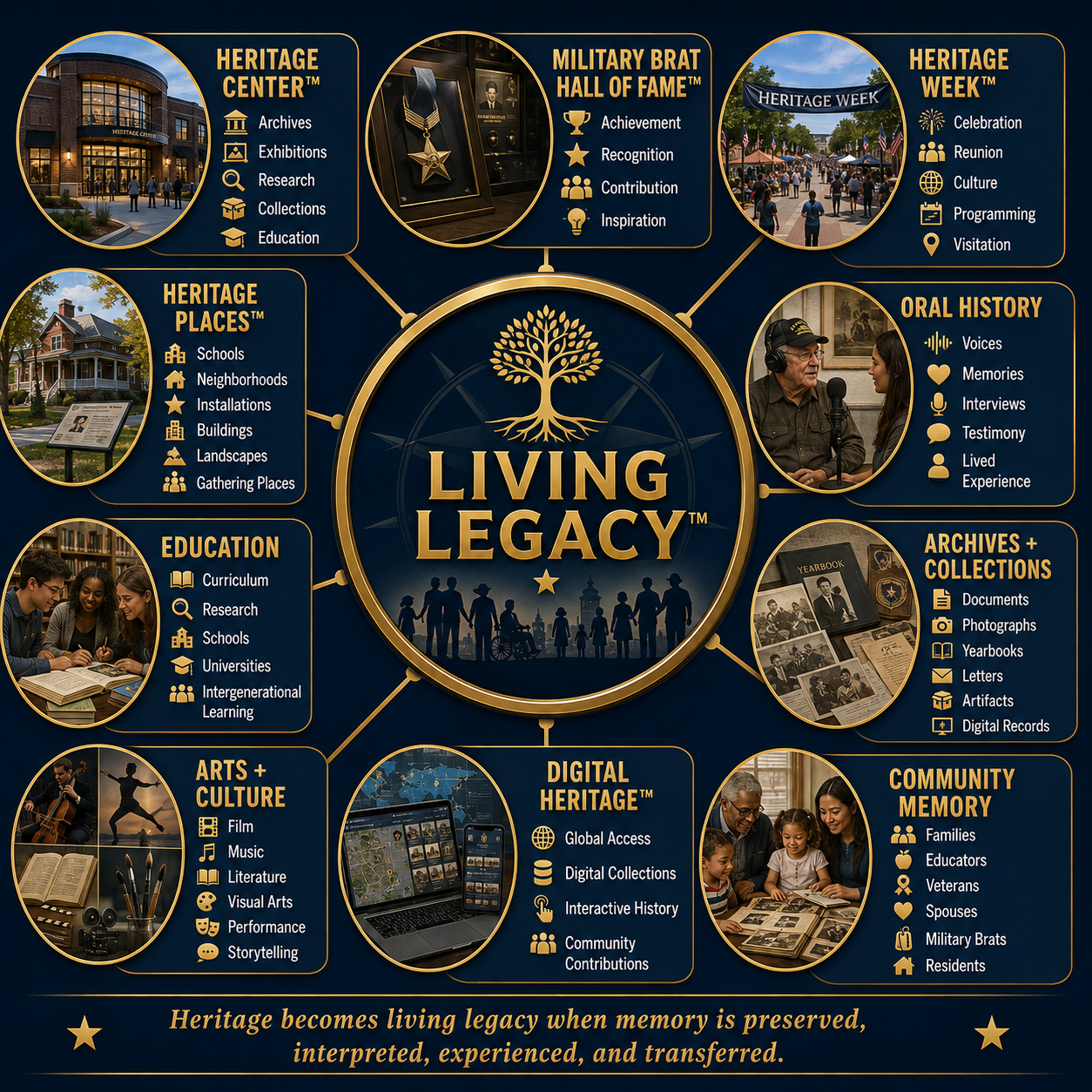
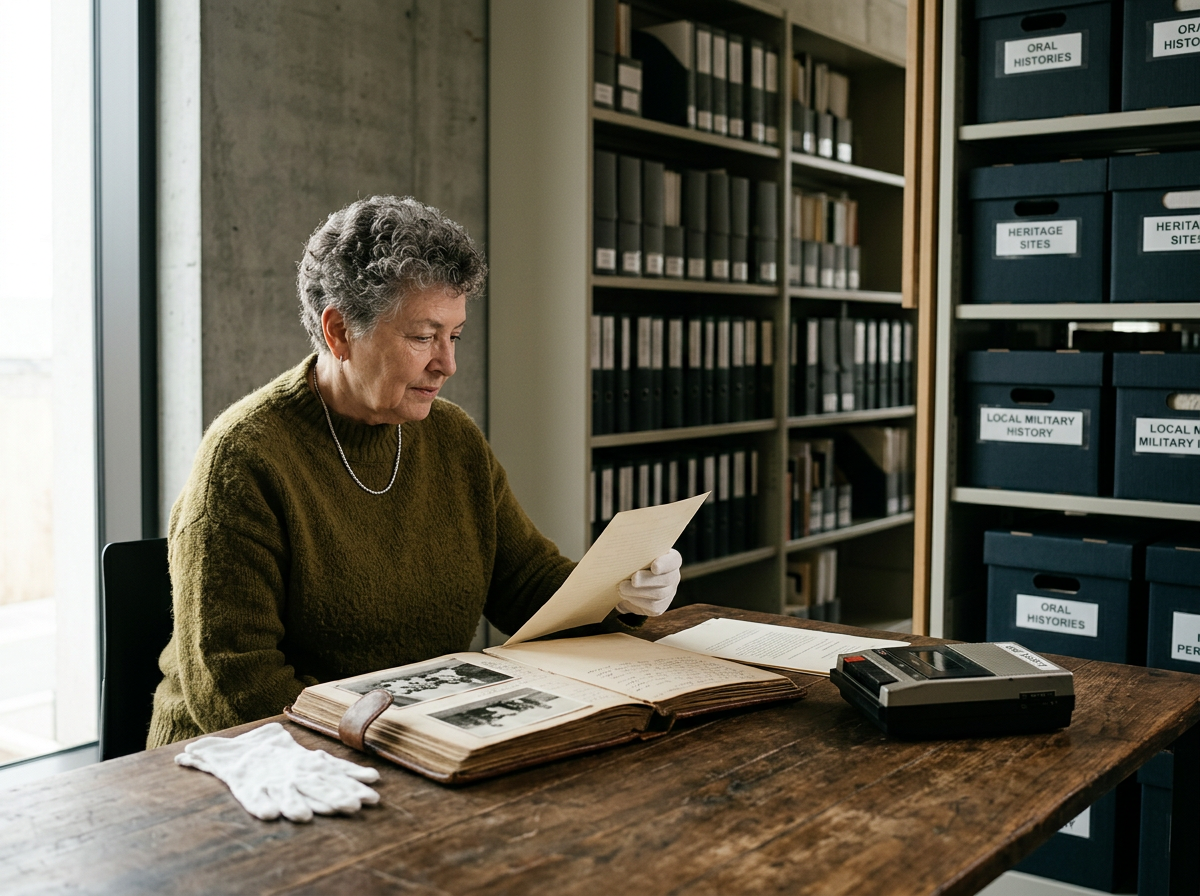
THE HERITAGE CENTER™
A Permanent Home for a Global Story.
The Heritage Center™ is one of the principal physical anchors of a Military-Connected Destination™.
But it should not be conceived simply as a museum.
It functions simultaneously as:
heritage institution;
archive;
exhibition environment;
research center;
education space;
oral-history studio;
community gathering place;
digital heritage hub;
and visitor destination.
Potential spaces could include:
Permanent Gallery
Rotating Exhibition Gallery
Military Brat Experience Gallery
Global Military Childhood Gallery
Oral History Studio
Research & Reading Room
Archives & Collections
Digital Heritage Lab
Education Studio
Community Story Gallery
Hall of Fame Gallery
Reflection Space
Event / Gathering Space
Museum Store / Heritage Marketplace
The Heritage Center™ becomes the place where dispersed military-connected history is brought together without pretending that one building can contain the entire story.
Defining Principle
A Permanent Home for a Community That Has Spent Generations Moving.™
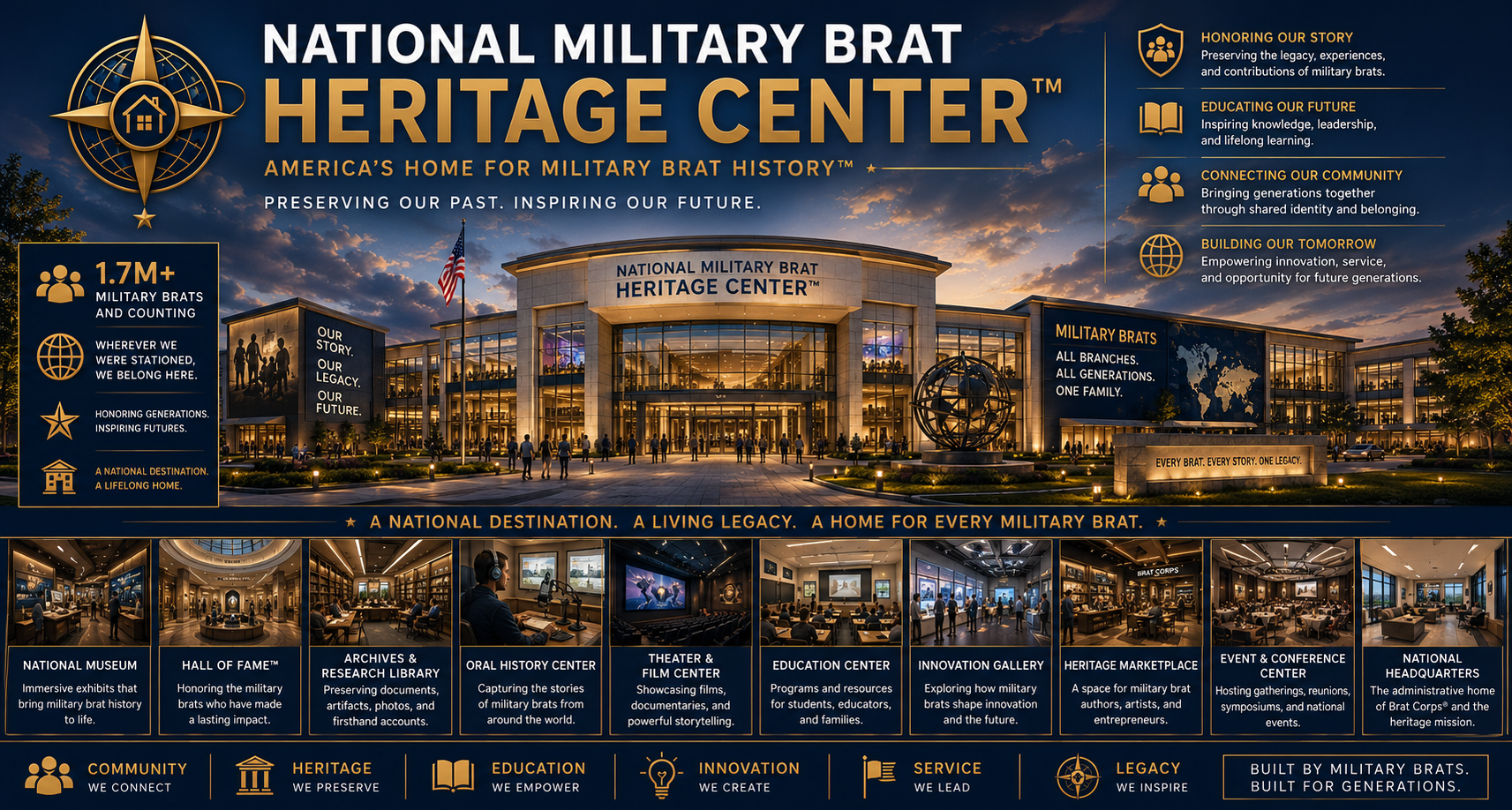
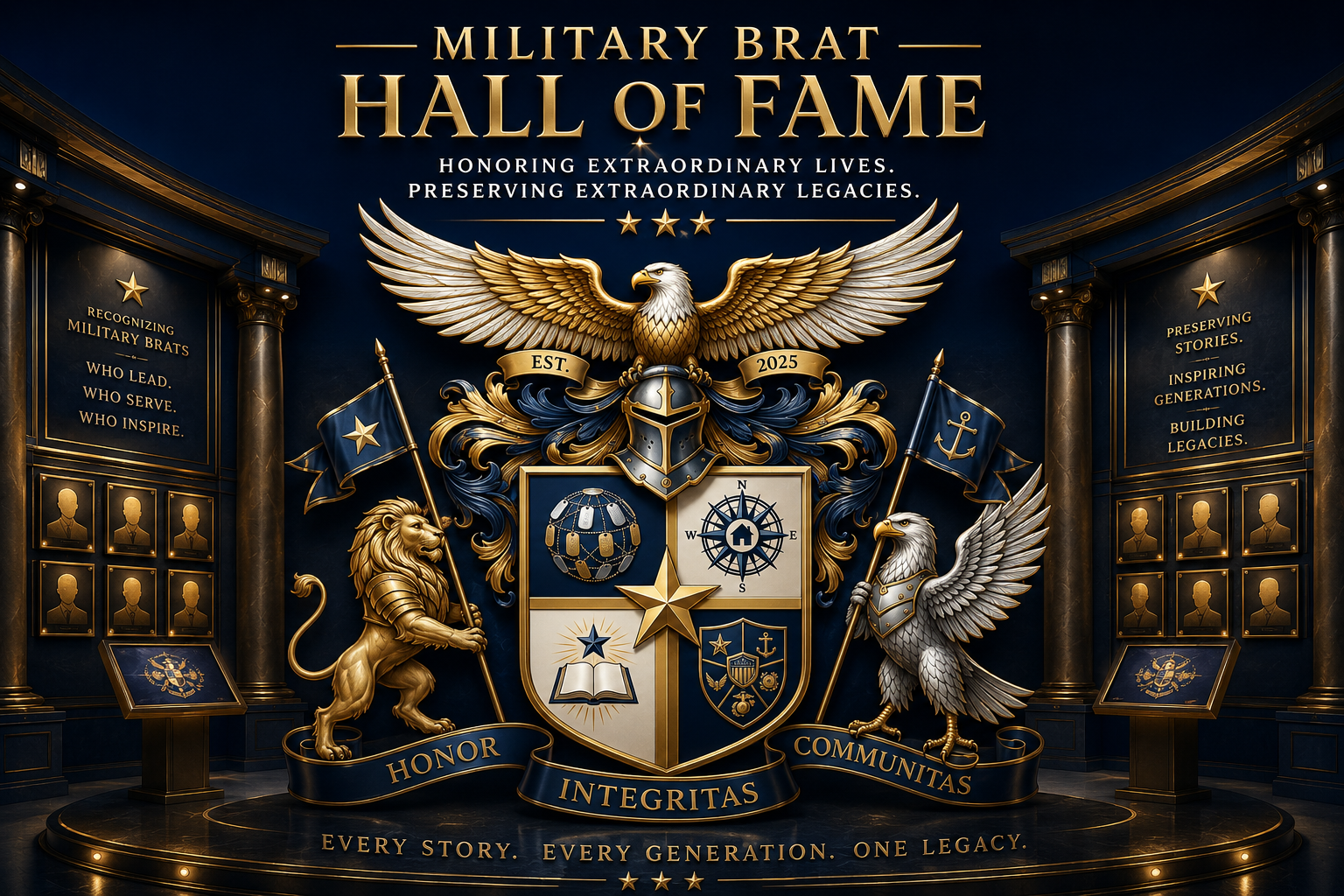
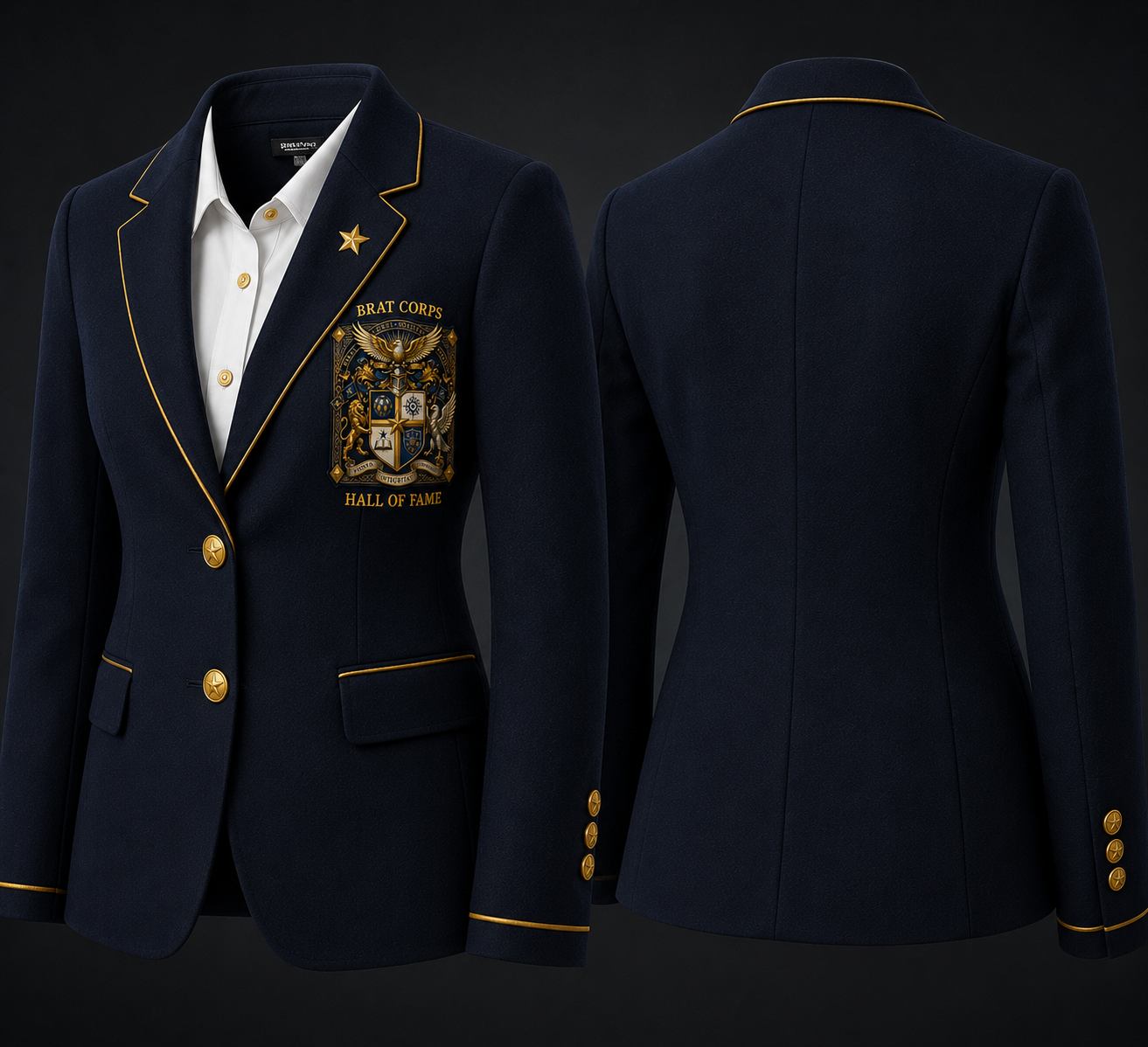
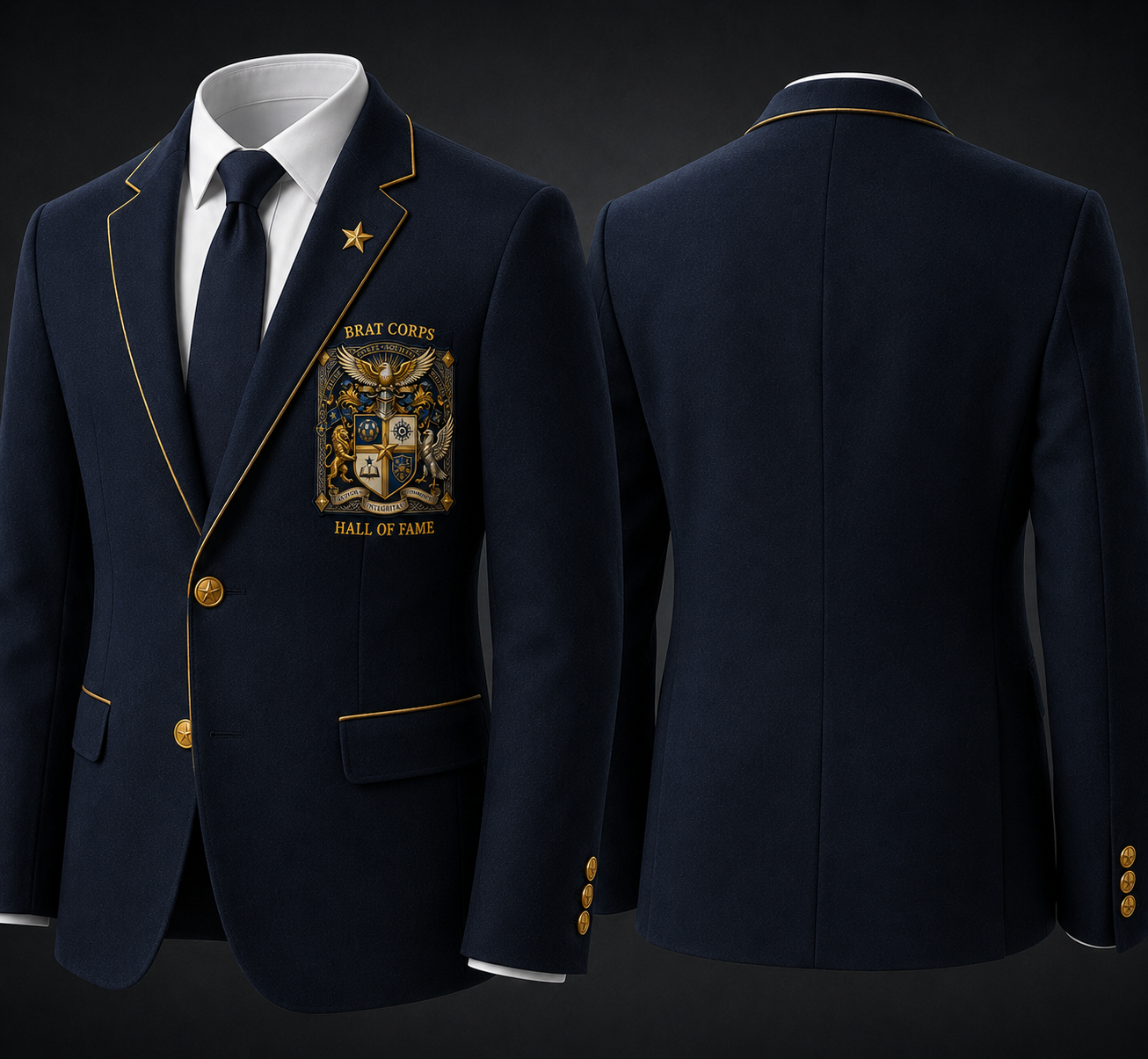
The Military Brat Hall of Fame™ is positioned as more than an awards ceremony.
Its deeper function is recognition, documentation, interpretation, and inspiration.
It honors military brats whose contributions demonstrate achievement or service across fields such as:
Public Service
Military Service
Education
Science + Technology
Business + Entrepreneurship
Arts + Humanities
Sports
Community Leadership
Humanitarian Service
Innovation
Global Leadership
Lifetime Contribution
Historical / Legacy Recognition
The Hall of Fame should also document:
where honorees lived;
their military-connected experience;
how mobility or community influenced their lives where relevant;
their contributions;
and the historical period through which they lived.
Recognition Should Preserve the Story Behind the Achievement.™
THE MILITARY BRAT HALL OF FAME™
HERITAGE WEEK™
When the Entire Destination Becomes the Heritage Experience.
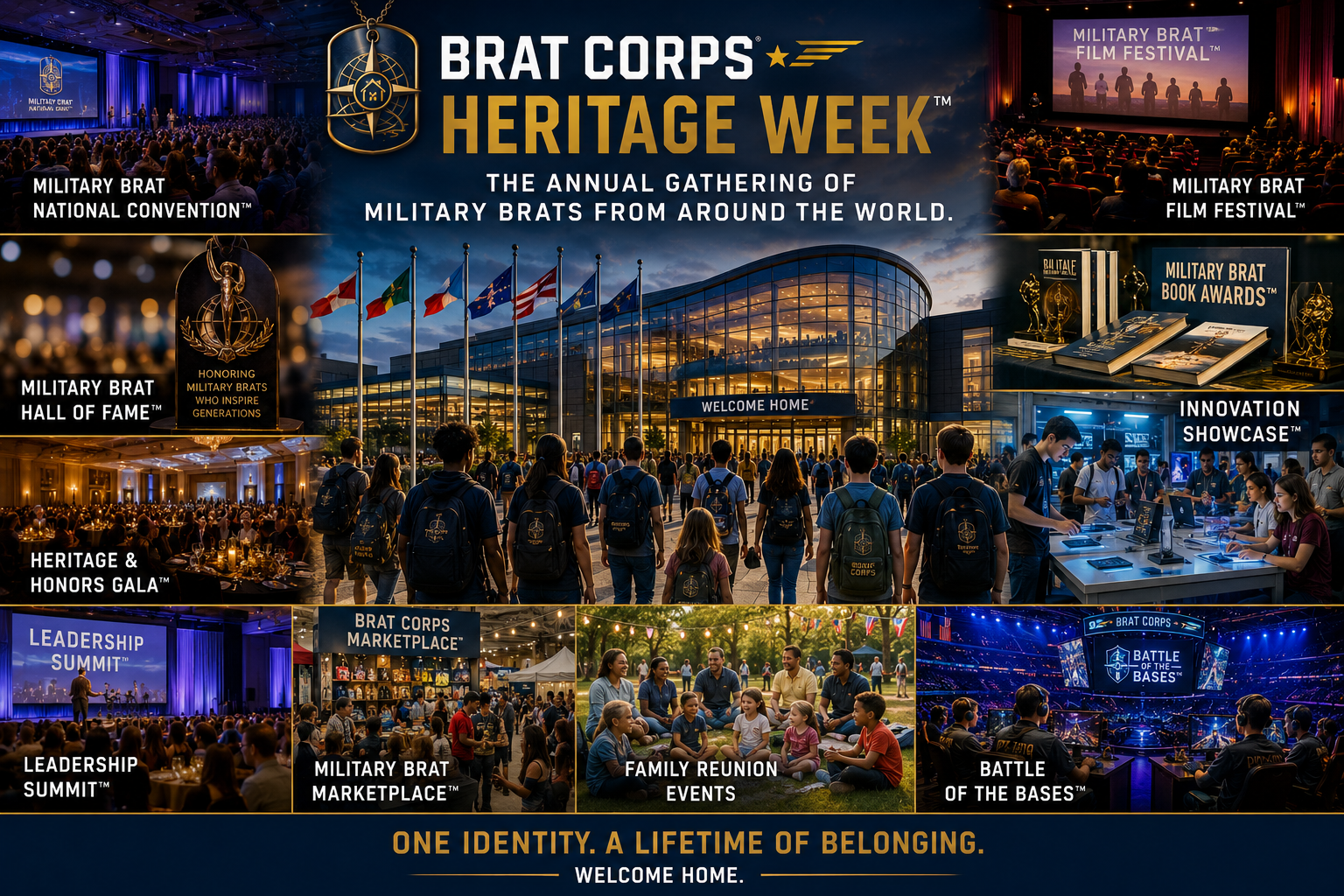
Heritage Week™ is one of the signatures recurring activations within Destination Legacy™ and Destination Events™.
This is where the destination's heritage leaves the archive and enters:
streets;
schools;
universities;
restaurants;
businesses;
public spaces;
cultural institutions;
Brat Corps® Posts™;
and community venues.
Potential programming could include:
Military Brat Hall of Fame™ induction;
reunions;
oral-history recording;
heritage exhibitions;
school and installation history programs;
film screenings;
author conversations;
arts performances;
heritage walks;
international military-brat programming;
food and cultural experiences;
veteran and family storytelling;
youth history projects;
and intergenerational conversations.
This creates a critical distinction:
Heritage Center™ preserves the story.
Heritage Week™ activates the story.
Destination Tourism™ helps people travel to experience the story.
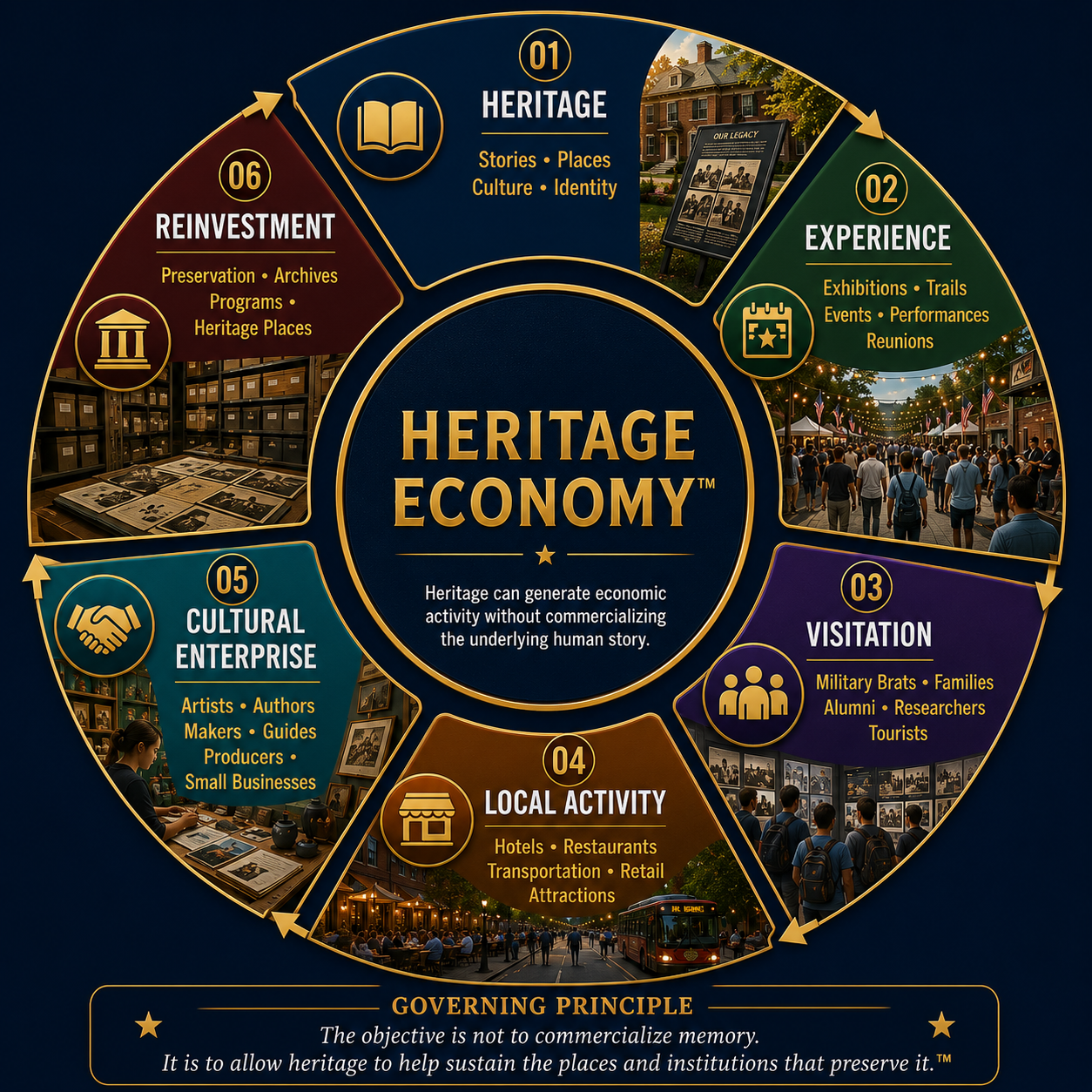
THE HERITAGE ECONOMY™
Heritage can generate economic activity without commercializing the underlying human story.
HERITAGE
Stories • Places • Culture • Identity
EXPERIENCE
Exhibitions • Trails • Events • Performances • Reunions
VISITATION
Military Brats • Families • Alumni • Researchers • Tourists
LOCAL ACTIVITY
Hotels • Restaurants • Transportation • Retail • Attractions
CULTURAL ENTERPRISE
Artists • Authors • Makers • Guides • Producers • Small Businesses
REINVESTMENT
Preservation • Archives • Programs • Heritage Places
LIVING HERITAGE ECONOMY™
Governing Principle
The objective is not to commercialize memory. It is to allow heritage to help sustain the places and institutions that preserve it. ™
PRESERVE MORE THAN FAMOUS STORIES™
History Is Larger Than Famous People.
Military-connected history cannot consist only of generals, political leaders, celebrities, decorated veterans, famous alumni, or nationally recognized military brats.
The historical record must also include:
the child who attended seven schools;
the family living overseas;
the educator who taught generations of military children;
the neighborhood outside the installation;
the teenager whose parent deployed;
the spouse who held the household together;
the youth-center director;
the school bus route;
the commissary;
the base theater;
the playground;
the football field;
the friendships interrupted by PCS;
the yearbook signed before another move;
and the places people still call home decades after leaving them.
Ordinary Lives Are Historical Evidence.™
ORAL HISTORY + THE LIVING ARCHIVE™
Capture the Story While the Storyteller Is Still Here.
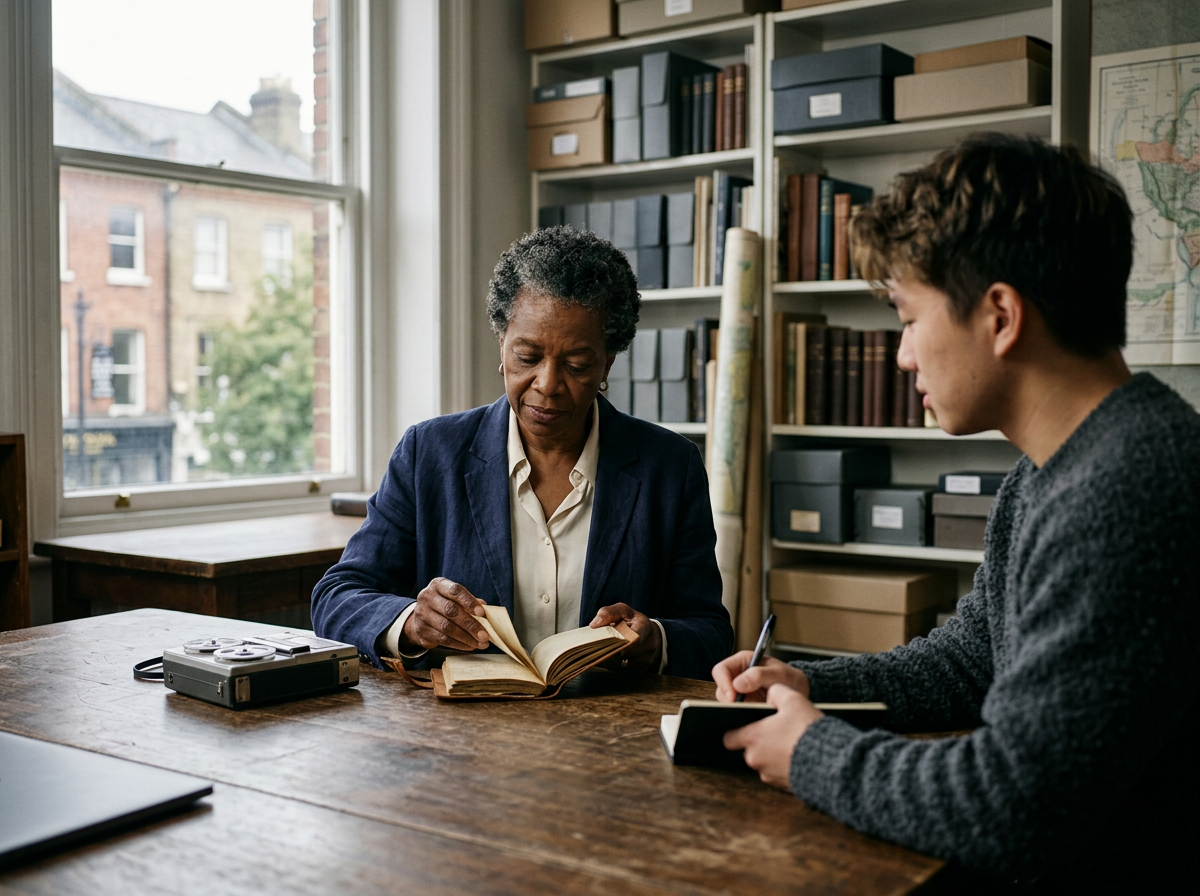
Destination Legacy™ establishes a structured oral-history program spanning generations.
Potential participants include:
military brats;
parents;
spouses;
veterans;
educators;
installation personnel;
civilian neighbors;
community leaders;
coaches;
school administrators;
and others whose lives intersected with military-connected communities.
Collections can be organized by:
era;
installation;
branch;
school;
country;
community;
conflict period;
family experience;
or theme.
This creates a Living Archive™ that grows continuously.
VOICE
RECORD
CATALOG
PRESERVE
INTERPRET
SHARE
REMEMBER™
HERITAGE PLACES™
Some Stories Live in Places.
Destination Legacy™ identifies physical places carrying military-connected historical meaning.
These might include:
former military housing;
schools;
youth centers;
neighborhoods;
historic installations;
rail stations;
airports;
community gathering places;
churches;
recreation areas;
commercial districts;
memorials;
and former facilities.
Not every site needs to become a museum.
Interpretation could occur through:
heritage markers;
digital interpretation;
walking trails;
QR-linked histories;
guided experiences;
public art;
oral histories;
historic designation where appropriate;
and preservation partnerships.
This gives us:
THE MILITARY-CONNECTED HERITAGE TRAIL™
DIGITAL HERITAGE™
A Global Community Requires a Global Archive.
Military brats are dispersed throughout the world.
Therefore, Destination Legacy™ cannot depend exclusively upon physical visitation.
Digital Heritage™ should eventually allow people to:
search collections;
contribute photographs;
identify people and places;
submit stories;
record oral histories;
explore former installations;
find school histories;
view exhibitions;
locate classmates;
explore maps;
and experience Heritage Center™ collections remotely.
A particularly compelling concept would be a:
GLOBAL MILITARY BRAT MEMORY MAP™
Imagine an interactive world map containing:
installations;
DoDEA and former military-connected schools;
communities;
oral histories;
photographs;
yearbooks;
heritage sites;
and individual memories attached to places.
A military brat could select Okinawa, Ramstein, Fort Hood/Fort Cavazos, Norfolk, Seoul, or another location and discover the stories associated with that place.
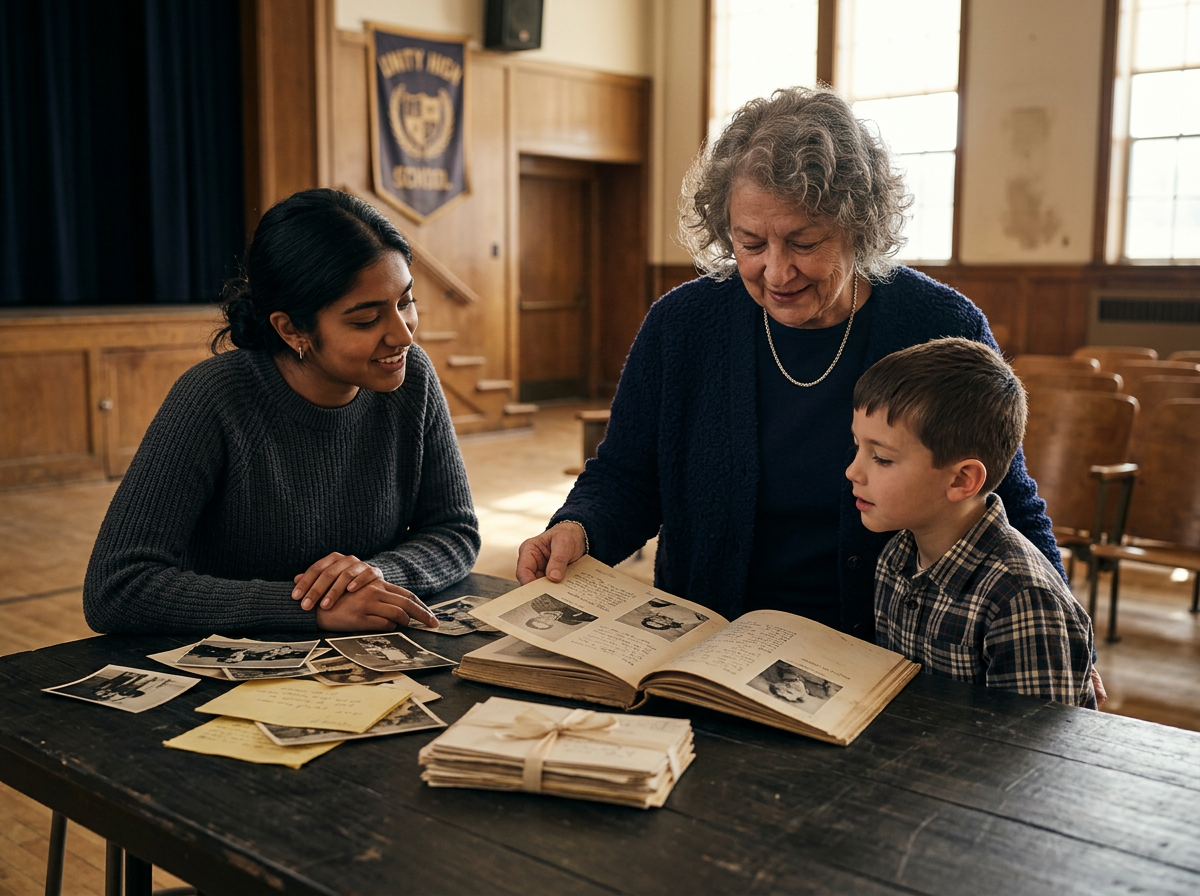
INTERGENERATIONAL MEMORY™
History Should Travel in Both Directions.
Older generations possess memory.
Younger generations possess new methods for interpreting, preserving, and sharing it.
Destination Legacy™ should intentionally connect them.
ELDERS
Memory • Experience • Context
CONVERSATION
Stories • Questions • Relationships
YOUTH
Research • Documentation • Technology • Interpretation
CREATION
Film • Podcasts • Exhibitions • Digital History • Art
SHARED MEMORY™
This is where Destination Legacy™ connects naturally with Destination Education™ and Destination Leadership™.
Older military brats are not simply subjects of history.
They become heritage mentors.
Young people are not merely audiences.
They become heritage stewards.
HERITAGE + EDUCATION
Destination Legacy™ becomes a learning resource.
Students can work with:
primary sources;
oral histories;
maps;
photographs;
letters;
artifacts;
yearbooks;
community histories;
and archival collections.
Potential learning areas include:
history;
geography;
civics;
migration;
international relations;
military history;
social history;
oral history;
digital humanities;
arts;
and research methodology..
This creates:
ARCHIVE
CLASSROOM
RESEARCH
INTERPRETATION
NEW KNOWLEDGE
NEXT GENERATION OF STEWARDS™
ARTS AS MEMORY™
Not every story belongs in a document.
Some histories survive through:
music;
photography;
film;
painting;
dance;
literature;
theater;
fashion;
craft;
and performance.
Destination Legacy™ therefore include arts and humanities as legitimate methods of historical interpretation.
This creates a natural institutional connection to existing military-child arts and humanities programming while giving it a permanent place inside the destination framework.
The question becomes:
How does a community remember what cannot be adequately expressed through an archive label?
Sometimes the answer is art.
PRESERVATION BEFORE LOSS™
Don't Wait Until Something Disappears to Decide It Mattered.
Destination Legacy™ develops mechanisms for identifying at-risk heritage.
That could include:
closing schools;
redeveloping neighborhoods;
installation changes;
historic military housing;
institutional archives;
retiring community leaders;
aging military-brat populations;
private collections;
and obsolete digital records.
The preservation process:
IDENTIFY
What may be lost?
DOCUMENT
What exists now?
ASSESS
Why does it matter?
PRIORITIZE
What requires intervention?
PRESERVE
Physical • Digital • Archival • Interpretive
CARRY FORWARD™
This turns heritage preservation from a reactive activity into an operating discipline.
LEGACY + DESTINATION DEVELOPMENT™
Development and preservation should not automatically be adversaries.
Destination Legacy™ helps Destination Development™ ask better questions before transformation occurs:
What happened here?
Who used this place?
What communities are connected to it?
What should be preserved?
What could be adaptively reused?
What stories should remain visible?
What should future residents know?
Therefore:
DEVELOPMENT
asks:
What can this place become?
LEGACY
asks:
What must this place never forget?
Together they create:
DEVELOPMENT WITH MEMORY™
LEGACY + DESTINATION TOURISM™
Destination Legacy™ can become one of the strongest demand generators within Destination Tourism™.
Potential heritage visitation drivers include:
Heritage Week™;
Military Brat Hall of Fame™;
Heritage Center™;
school reunions;
installation reunions;
heritage trails;
archives and research;
film festivals;
arts programming;
historical exhibitions;
international military-brat gatherings;
and commemorative events.
This creates a visitor proposition that cannot simply be copied by another city.
Because:
Heritage Is Place-Specific.
A destination's authentic history becomes part of its competitive identity.
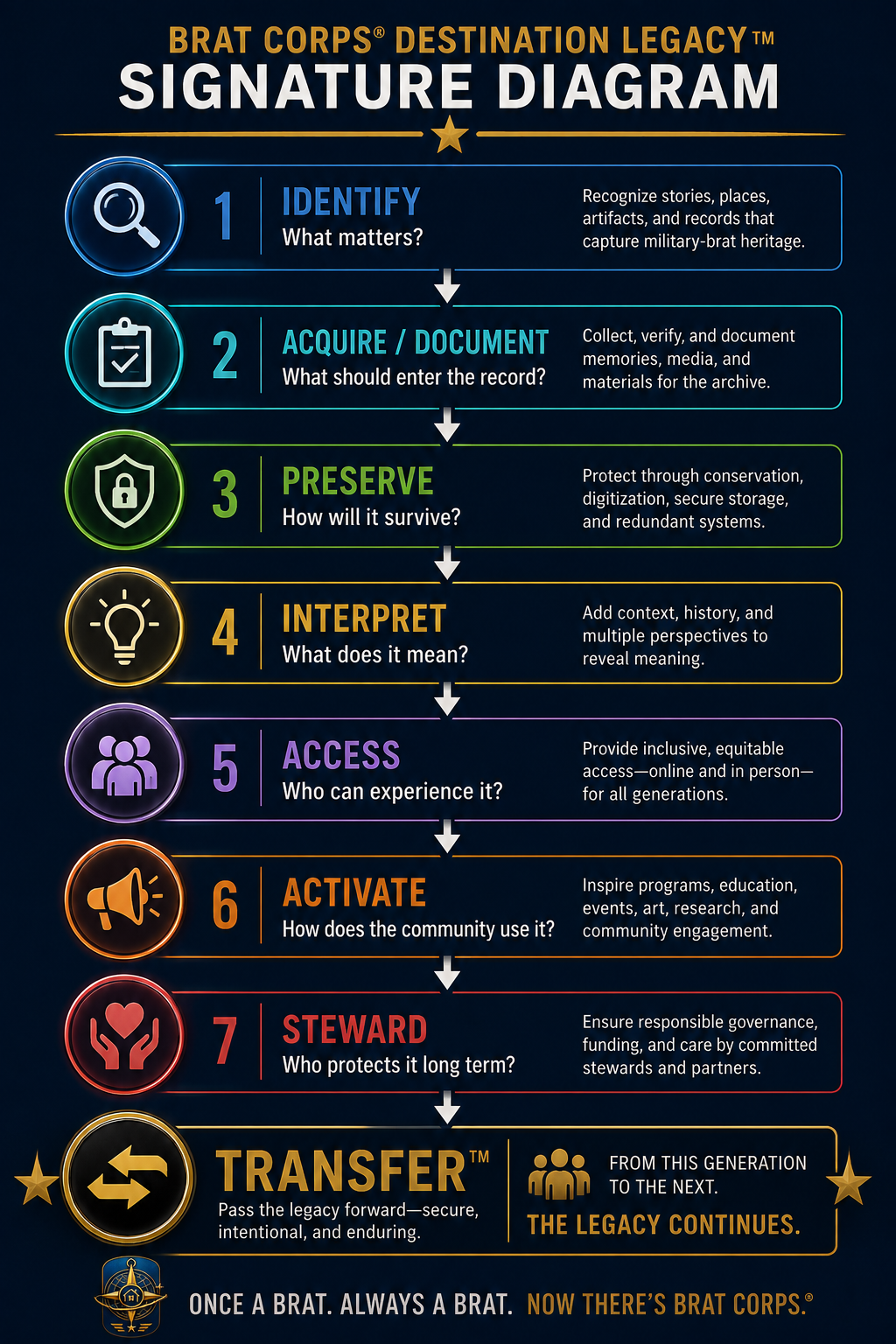
THE LEGACY STEWARDSHIP MODEL™
Heritage institutions must themselves endure.
IDENTIFY
What matters?
ACQUIRE / DOCUMENT
What should enter the record?
PRESERVE
How will it survive?
INTERPRET
What does it mean?
ACCESS
Who can experience it?
ACTIVATE
How does the community use it?
STEWARD
Who protects it long term?
TRANSFER™
The critical distinction:
Collecting is not stewardship.
Stewardship requires preservation, access, interpretation, governance, funding, and continuity.
MEASURING LEGACY
Destination Legacy™ eventually contribute indicators to the Destination Index™.
Potential measures could include:
oral histories collected;
collections preserved;
heritage sites documented;
digital collections accessible;
school participation;
research utilization;
Heritage Week™ participation;
Hall of Fame™ engagement;
heritage visitation;
intergenerational participation;
community contributions;
at-risk materials preserved;
and resident awareness of local military-connected history.
But quantitative metrics alone will not be sufficient.
We also evaluate:
representation;
historical accuracy;
accessibility;
community trust;
interpretive quality;
and whose stories remain absent.
That final question matters.
THE LEGACY TEST™
Before calling a destination's heritage system successful, ask:
Whose stories are being preserved?
Whose stories are missing?
Can residents contribute to the historical record?
Are ordinary lives represented?
Are physical places being documented before they disappear?
Are older generations being recorded?
Can young people access and interpret the collections?
Can people participate from outside the destination?
Does heritage strengthen community identity?
Does preservation influence development decisions?
Are the collections protected for the long term?
And ultimately:
If We Returned 50 Years From Now, Would We Still Know Who This Community Was?
That is the Destination Legacy™ test.
HOW DESTINATION LEGACY™ FITS WITHIN MCD
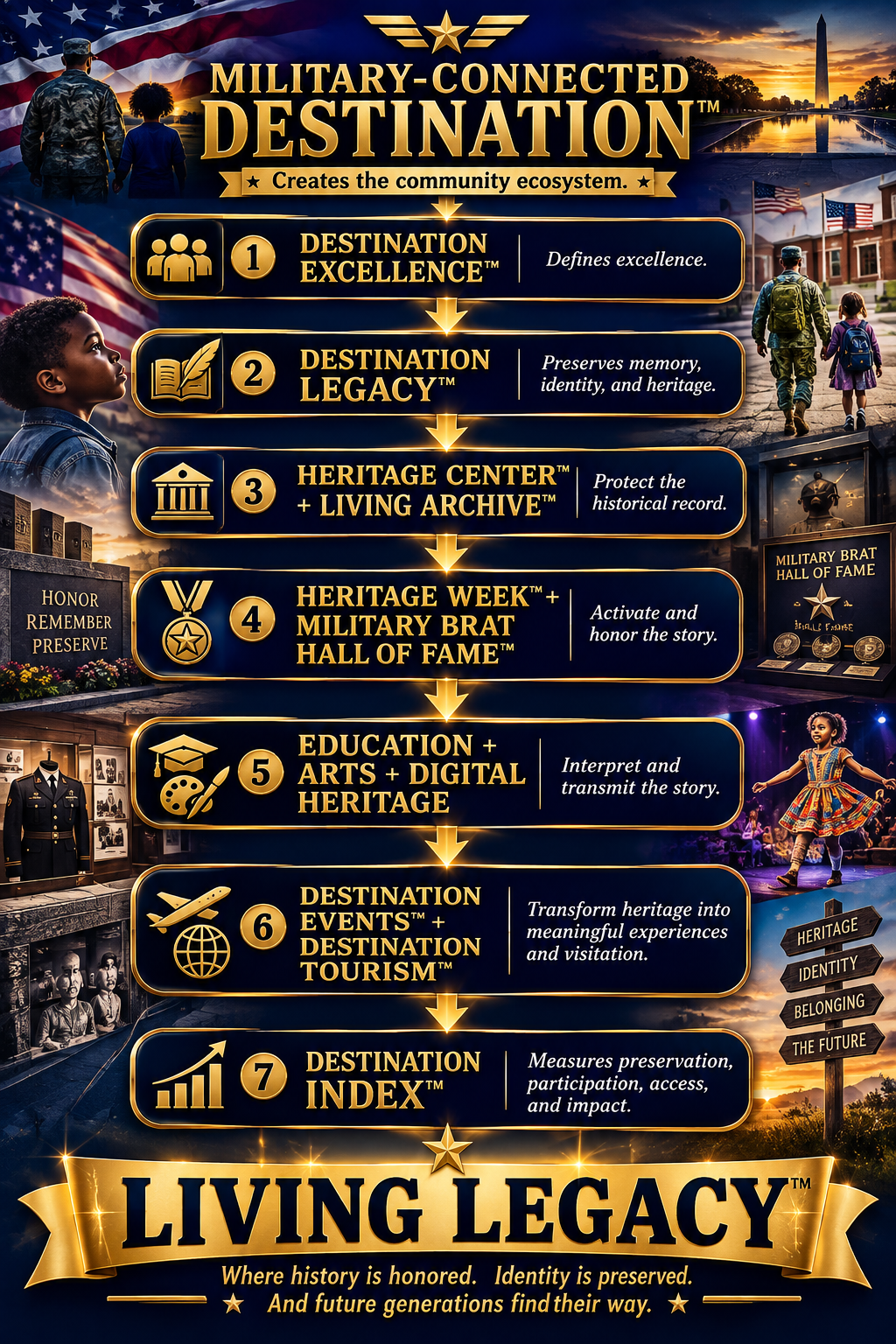
MILITARY-CONNECTED DESTINATION™
Creates the community ecosystem.
DESTINATION EXCELLENCE™
Defines excellence.
DESTINATION LEGACY™
Preserves memory, identity, and heritage.
HERITAGE CENTER™ + LIVING ARCHIVE™
Protect the historical record.
HERITAGE WEEK™ + MILITARY BRAT HALL OF FAME™
Activate and honor the story.
EDUCATION + ARTS + DIGITAL HERITAGE
Interpret and transmit the story.
DESTINATION EVENTS™ + DESTINATION TOURISM™
Transform heritage into meaningful experiences and visitation.
DESTINATION INDEX™
Measures preservation, participation, access, and impact.
LIVING LEGACY™
What We Preserve Determines What the Future Can Remember. ™
Every photograph matters to someone.
Every school held a community.
Every PCS left a story.
Every generation inherited something from the generation before it.
Destination Legacy™ creates the institutional capacity to ensure those stories do not simply disappear as people and places change.
Preserve the memory.
Honor the contribution.
Tell the story.
Teach the next generation.
Protect the places that matter.
Carry it forward.
Because a community's legacy should not be left to chance.
Share Your Story | Contribute to the Archive | Explore Heritage Week™ | Discover the Military Brat Hall of Fame™