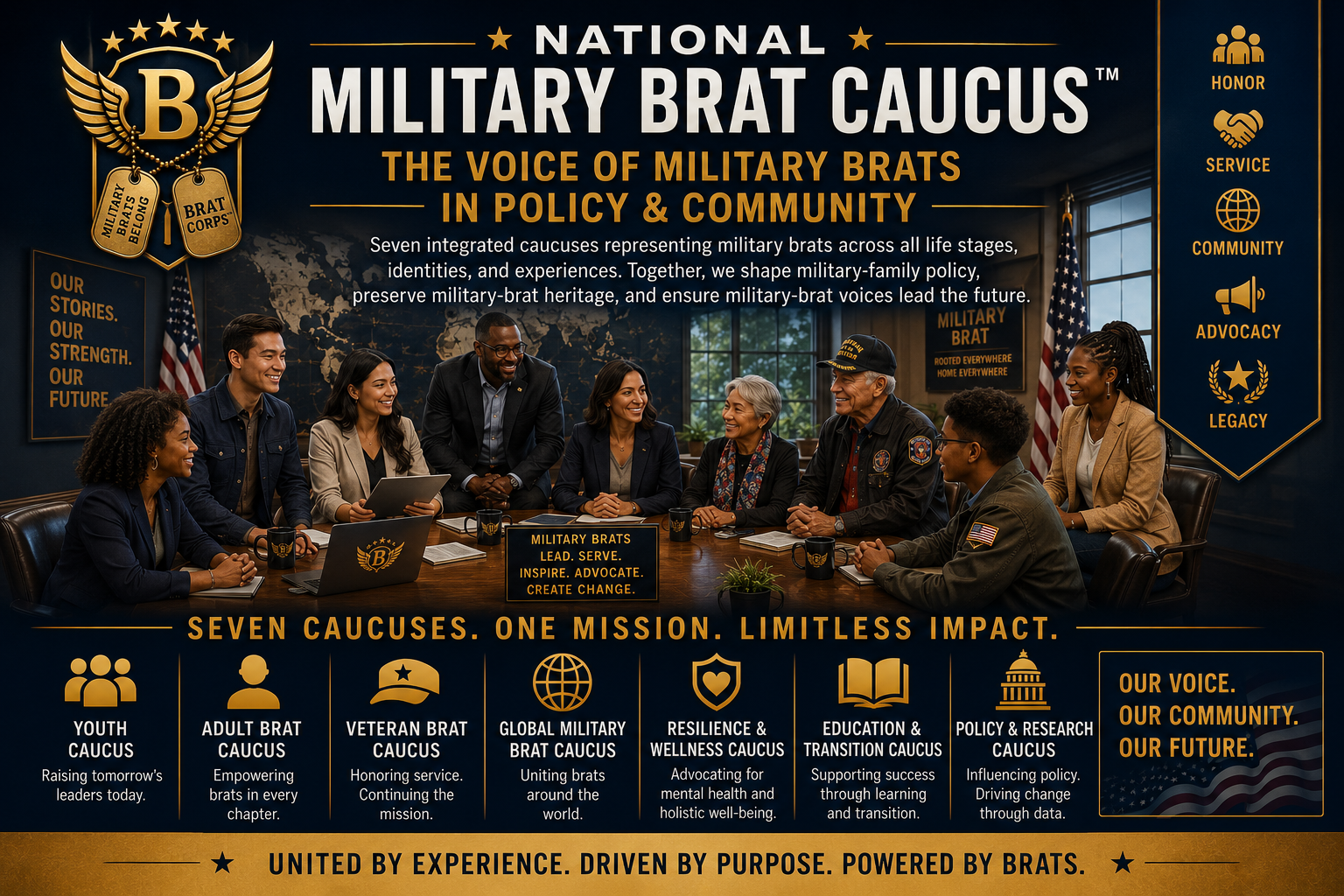
Seven integrated caucuses representing military brats across all life stages, identities, and experiences.
Together, we shape military-family policy, preserve military-brat heritage, and ensure military-brat voices lead the future.
WHAT IS THE NATIONAL MILITARY BRAT CAUCUS™?
The National Military Brat Caucus™ Seven United Voices
The National Military Brat Caucus™ is a unified leadership network of military brats, organized into seven integrated caucuses.
Each caucus represents a distinct community within military-brat identity: youth, heritage, global perspective, adaptive diversity, education and transitions, and policy and research.
Together, the seven caucuses create a comprehensive voice for military brats in national policy, community leadership, and cultural preservation.
For too long, military brats have been spoken for rather than by. Policymakers, military leaders, and nonprofits make decisions about military families without hearing directly from military brats themselves.
The National Military Brat Caucus™ changes that. We are military brats leading the conversation about our own lives, our own futures, and our own communities.
Our structure is intentionally inclusive and intergenerational.
The Youth Caucus™ develops the next generation of military-brat leaders (ages 18–30).
The Military Brat Caucus™ serves adult brats (ages 31–60) navigating careers, families, and civic participation.
The Heritage Caucus™ honors elder military brats (ages 60+) and preserves military-brat history and culture.
The Global Military Brat Caucus™ connects military brats across NATO allies (UK, Canada, Germany, Australia, Japan, etc.).
The Adaptive Futures Caucus™ centers military brats with disabilities and neurodivergence.
The Education, Mobility & Transition Caucus™ focuses on educational equity and transition support.
And the Policy, Research & Strategic Affairs Caucus™ develops evidence-based solutions to military-family challenges.
This is not a social club. This is a political and cultural movement. Military brats are organizing to shape the future of military-family policy, preserve our unique identity and heritage, and ensure that every military brat, regardless of age, ability, background, or geography, has a voice that matters.
National Military Brat Caucus™
The Voice of Military Brats in Policy & Community
CAUCUS PURPOSE & MISSION
Our Purpose & Mission
"The National Military Brat Caucus™ convenes military-brat leaders across all life stages to shape military-family policy, preserve military-brat identity and heritage, advance equity and inclusion, and ensure that military-brat voices lead decisions affecting our lives and futures."
Core Purposes (5 interconnected pillars)
Purpose 1
Policy Advocacy & Leadership
Military brats drive federal, state, and local policy on issues affecting our community. We research, develop, and advance legislation on military-family well-being (transition support, education, mental health, esports, etc.). We testify before Congress, brief military leadership, and ensure military-brat perspectives inform all policy decisions.
Purpose 2
Community Belonging & Identity
The Caucus creates spaces for military brats to connect across generations, regions, and branches. We celebrate military-brat identity as a distinct and valuable part of American culture. We affirm that military-brat experiences—moves, resilience, global perspective, service—are sources of strength, not deficit.
Purpose 3
Heritage Preservation & Storytelling
We preserve and celebrate military-brat history, culture, and contributions. We document oral histories, celebrate military-brat achievements, and ensure future generations understand what it means to be a military brat. We honor military brats across all eras (WWII-era brats to Gen Z brats today).
Purpose 4
Equity & Inclusion
The Caucus centers military brats who are often marginalized: people of color, LGBTQ+ brats, brats with disabilities, adult brats, international military brats. We actively work against discrimination and ensure all military brats feel welcome and represented.
Purpose 5
Global Leadership & Coalition
We extend military-brat identity and advocacy beyond the U.S. We build coalition with military-connected youth in NATO allies (UK, Canada, Germany, Australia, Japan, etc.). We establish international standards for military-brat well-being and create cross-country pathways for youth exchange and collaboration.
Seven Integrated Caucuses, One United Voice
THE SEVEN CAUCUSES
The National Military Brat Caucus™ comprises seven specialized caucuses, each serving a distinct community within military-brat identity while contributing to unified national advocacy and leadership.
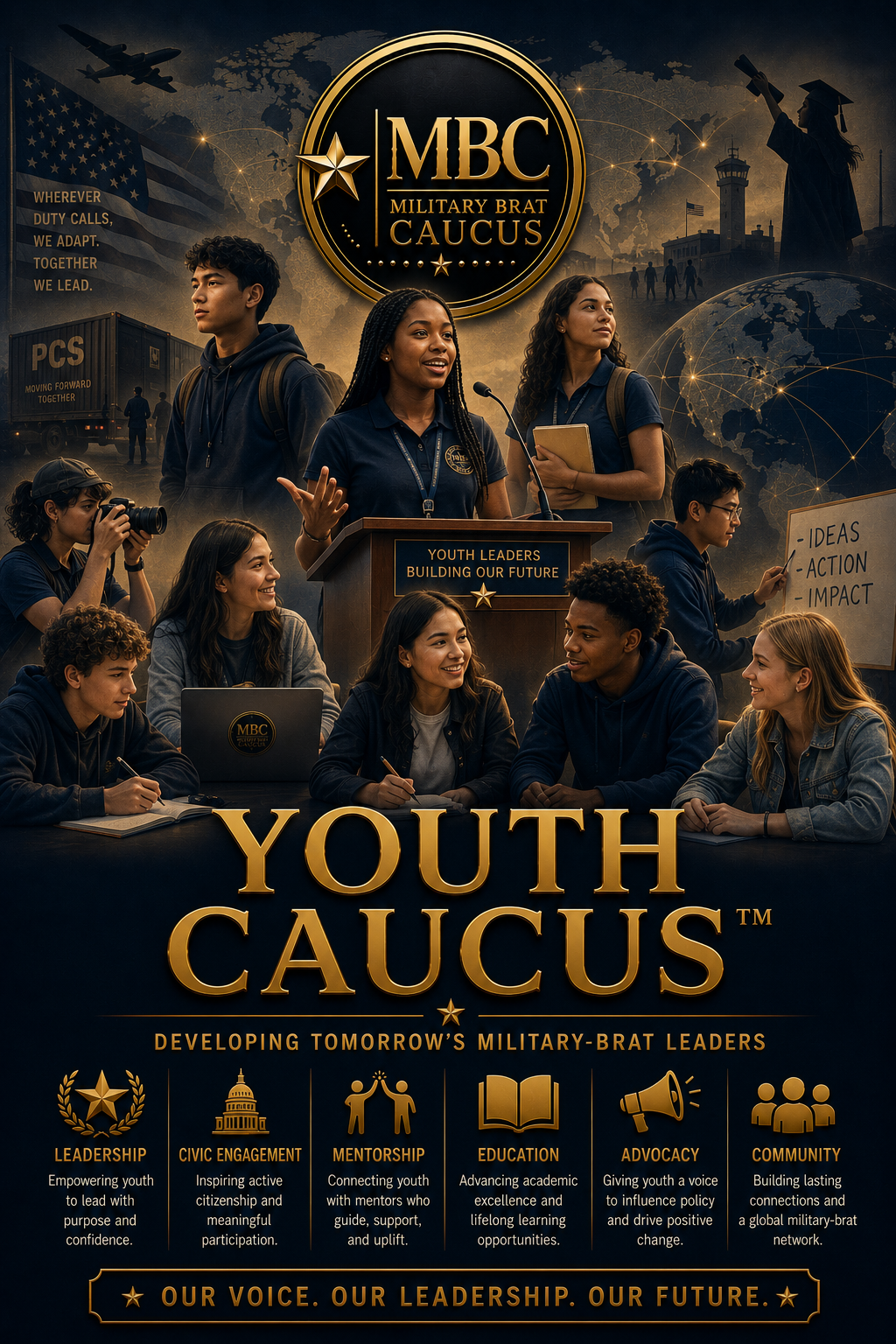
The Next Generation of Military-Brat Leaders
YOUTH CAUCUS™
Purpose: Develop emerging military-brat leaders; create peer community for young adults; build pathways to civic engagement, career development, and community leadership.
Community Characteristics:
Recently aged out of youth programs (or entering adulthood)
Navigating college, early career, independence, identity
First-time civic participation and advocacy
Building families and professional identities
Often experiencing first post-military-service life stage
Key Programs & Activities:
1. Youth Leadership Academy
Format: 6-month cohort-based program (quarterly cohorts)
Participants: 30–50 youth per cohort
Focus: Leadership skills, civic engagement, career development, identity exploration
Modules:
Month 1: Military-brat identity and leadership
Month 2: Policy advocacy and Congress
Month 3: Media, communications, public speaking
Month 4: Community organizing and coalition building
Month 5: Career pathways and professional development
Month 6: Capstone project (individual advocacy initiative)
Outcome: Graduates become active Caucus leaders; many move to other Caucus roles
Cost: Free for members
2. Quarterly Youth Leadership Summits
Format: 2-day regional summits (4 per year across regions)
Participants: 100–200 youth per summit
Activities: Keynotes, workshops, networking, mentorship speed-dating, advocacy training
Outcomes: Community building, skill development, recruitment to leadership roles
3. Young Professional Network
Format: Monthly virtual meetings + annual in-person conference
Focus: Career development, professional networking, work-life balance as military-brat professional
Topics: Job search, salary negotiation, work-family integration, career transitions
Guest Speakers: Military-brat professionals across fields (law, medicine, tech, military, nonprofits, etc.)
4. Civic Engagement Projects
Grassroots Advocacy: Constituent campaigns (letters, calls, social media)
Media Projects: Op-eds, social media content, podcasts, documentaries
Research: Conduct original surveys and research on military-brat experiences
Community Service: Organize volunteer initiatives, mentorship programs
5. Mentorship Matching
Format: Pair young brats with established military-brat leaders (adult brats, policy makers, nonprofit leaders)
Duration: 6–12 months
Focus: Career guidance, civic leadership, identity exploration, life transitions
Membership Benefits:
Free access to all Youth programs
Monthly stipend ($100–$300) for active leaders
Networking with 500+ youth leaders nationally
Media training and speaking opportunities
Mentorship and professional development
Participation Requirement: Ages 18–30, military-brat identity (or 5+ years military-family connection)
Leadership Structure: Youth Caucus Chair (elected annually) + 4–5 regional co-chairs (elected)
"Join Youth Caucus™" → bratcorps.org/caucus/youth/join
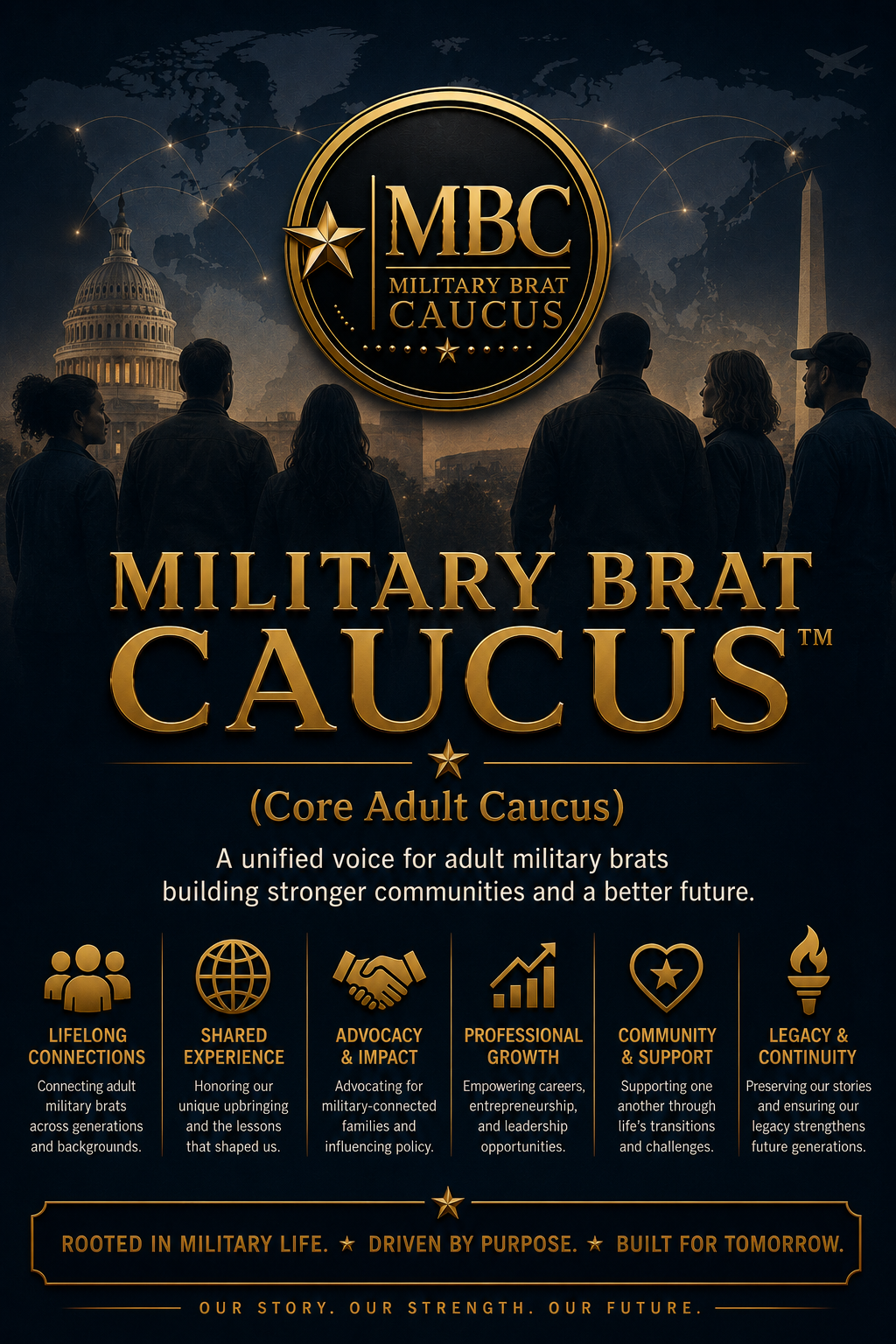
Military Brat Caucus™
Adult Military-Brat Leadership & Community
MILITARY BRAT CAUCUS™ (Core Adult Caucus)
Age Focus: 31–60 years old (established adults)
Purpose: Serve adult military brats navigating careers, families, civic leadership; integrate military-brat identity into adult life; create peer community across life stages and professions.
Community Characteristics:
Established in careers (mid-to-senior professional level)
Managing families (some with military-brat children, continuing the identity)
Civic engagement and community leadership
Integrating military-brat identity with adult responsibilities
Often in policy, nonprofit, business, military, education sectors
Key Programs & Activities:
1. Professional Network & Career Development
Format: Monthly virtual networking + annual in-person conference
Focus: Career advancement, professional leadership, work-family integration
Topics: Executive leadership, career transitions, entrepreneurship, work as military brat
Guest Speakers: Military-brat executives, nonprofit leaders, military officers
2. Civic Leadership Council
Format: Quarterly meetings (virtual + annual in-person retreat)
Purpose: High-level policy development and advocacy strategy
Members: 30–50 military-brat leaders in policy, law, military, education, nonprofits
Activities:
Develop legislative proposals and policy briefs
Brief Congressional staff and military leadership
Lead major advocacy campaigns
Mentor emerging leaders
3. Parent Brats Network
Format: Monthly virtual community + annual summit
Focus: Parenting military-brat children; integrating military-brat identity across generations
Topics: Parenting resilience, school transitions, military family identity, preparing children for military life
Expert Speakers: Family therapists, military-family researchers, veteran parents
4. Intergenerational Mentorship
Format: Match adult brats with elder brats (Heritage Caucus) for mentorship
Duration: 6–12 months
Focus: Career wisdom, life integration, legacy and impact
5. Community Leadership Development
Advocacy Training: Advanced skills in policy analysis, legislative drafting, Congressional engagement
Media Training: Op-ed writing, podcast interviews, public speaking
Nonprofit Leadership: Board service, executive leadership, nonprofit strategy
Membership Benefits:
Access to all Adult Caucus programs and networking
Participation in policy development and legislative briefs
Speaking and testimony opportunities
Leadership positions in major advocacy campaigns
Mentorship from senior military-brat leaders
Participation Requirement: Ages 31–60, military-brat identity, established professional or civic role
Leadership Structure: Military Brat Caucus Chair (elected annually) + 4–5 regional co-chairs
"Join Military Brat Caucus™" → bratcorps.org/caucus/adult/join
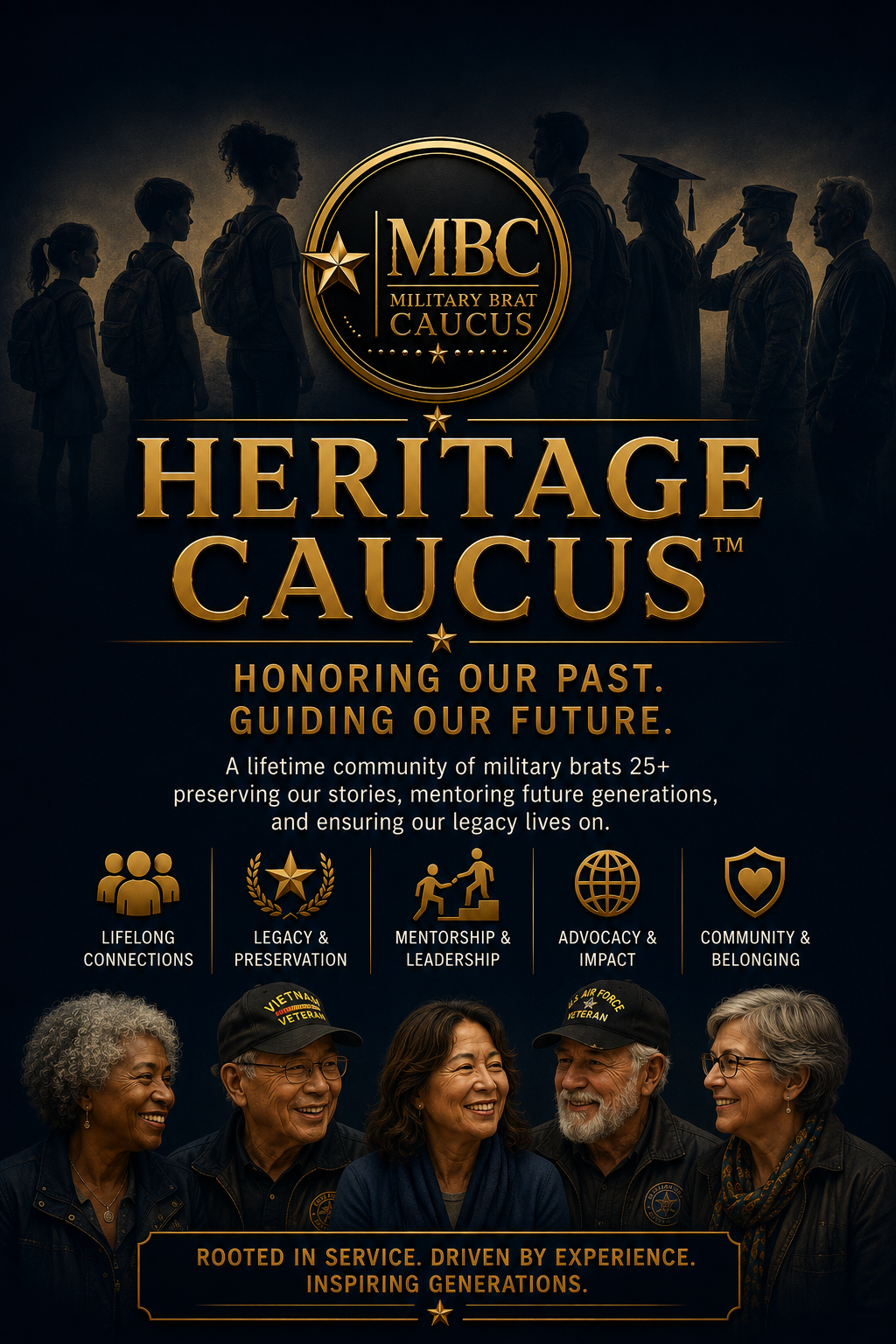
Heritage Caucus™ Honoring Military-Brat History & Elders
HERITAGE CAUCUS™
Age Focus: 60+ years old (elder military brats; multi-generational representation)
Purpose: Honor and celebrate elder military brats; preserve military-brat history and culture; create intergenerational knowledge transfer; celebrate military-brat contributions across generations.
Community Characteristics:
Retired or semi-retired
Witnessed multiple eras of military-brat experience (post-WWII through Gen X)
Long professional careers and civic contributions
Interested in legacy and wisdom-sharing
Potential grandchildren who are military brats (multi-generational)
Key Programs & Activities:
1. Oral History & Storytelling Project
Format: Record video interviews with elder military brats
Focus: Life stories, military-brat experiences across eras, lessons learned, advice for future generations
Output: Video archive (public and private), transcript library, podcast series
Participation: 50–100 oral histories per year; all preserved for future generations
2. Elder Brat Mentorship Program
Format: Match elder brats with younger military-brat leaders (Youth and Adult Caucuses)
Duration: 6–12 months
Focus: Life wisdom, career mentoring, legacy and impact, navigating transitions
Outcome: Intergenerational knowledge transfer; elder brats feel valued and connected
3. Military-Brat History & Archives
Format: Curate exhibitions, books, documentaries celebrating military-brat history
Topics: Military brats across eras (1950s–2020s); contributions to military, business, arts, policy; challenges and resilience stories
Outlets: Brat Corps museum partnership, Smithsonian oral history project, educational materials
Participation: Elder brats contribute stories, artifacts, expertise
4. Legacy Leadership
Format: Advisory roles in policy and advocacy
Focus: Bring historical perspective to current military-family policy debates
Activities: Write op-eds reflecting on 60+ years of military-brat history, advise on long-term strategy, mentor younger leaders
5. Celebration & Recognition
Annual Heritage Gala: Celebrate elder military-brat accomplishments and contributions
Military Brat Hall of Fame: Nominate and honor elder military brats
Heritage Month Events: April celebration of military-brat identity (with special elder brat focus)
Membership Benefits:
Community of 500+ elder military brats nationally
Opportunities to share stories and legacy
Mentorship of younger generation
Invitations to special events and celebrations
Recognition through Hall of Fame nominations
Participation Requirement: Age 60+, military-brat identity (any era)
Leadership Structure: Heritage Caucus Chair (elected annually) + Regional representatives
"Join Heritage Caucus™" → bratcorps.org/caucus/heritage/join
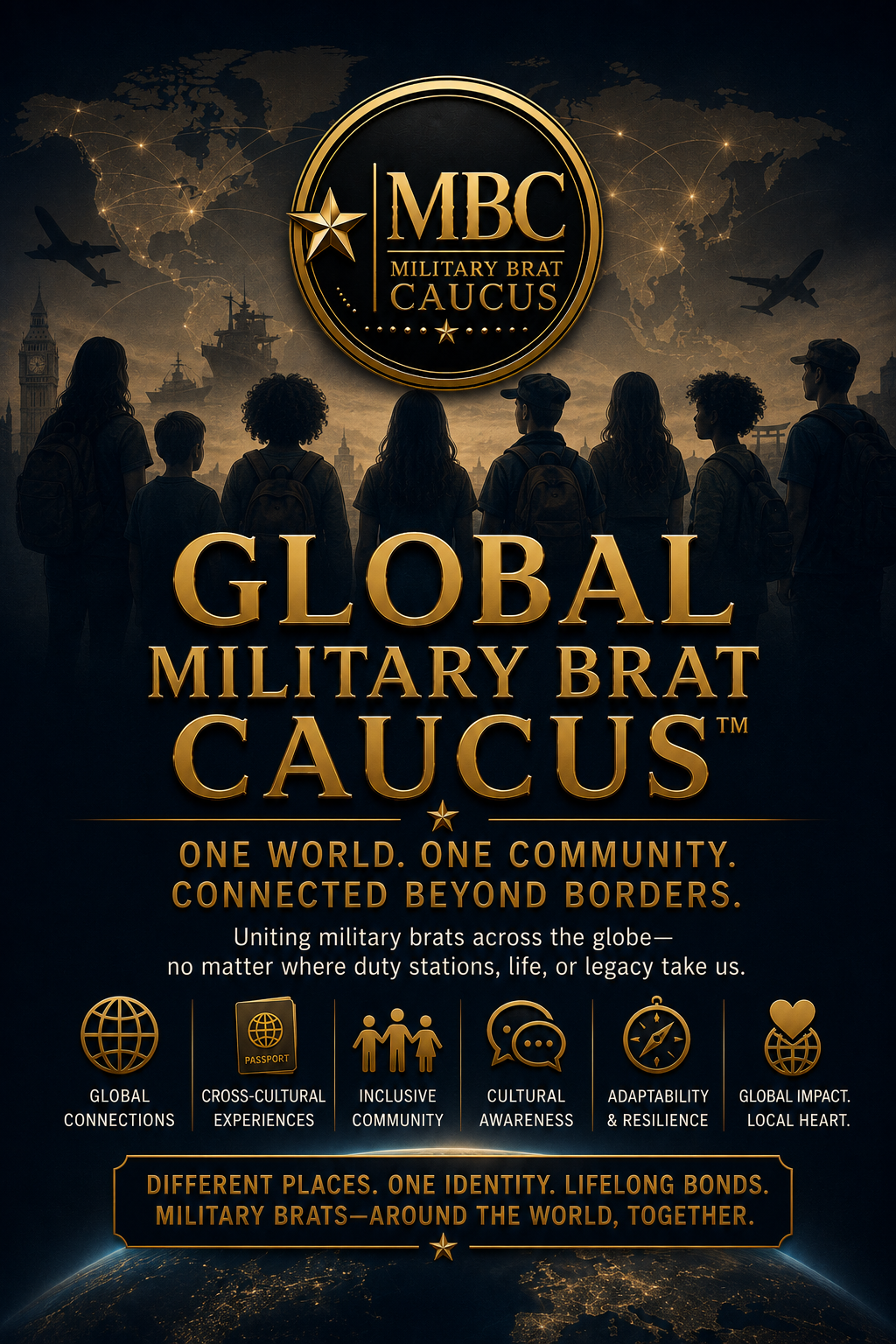
Global Military Brat Caucus™ International Military-Connected Leadership
GLOBAL MILITARY BRAT CAUCUS™
Geographic Focus: NATO allies and international military-connected communities (UK, Canada, Germany, Australia, Japan, South Korea, etc.)
Purpose: Build coalition with military-connected youth and families globally; establish international standards for military-brat well-being; create pathways for youth exchange and collaboration; advocate for military-family support across nations.
Community Characteristics:
Military-connected individuals from NATO-allied countries
U.S. military families stationed internationally
International military-connected esports community
Advocates for military-family policy in their home countries
Interested in cross-country collaboration and peer support
Key Programs & Activities:
1. International Coalition Leadership
Format: Quarterly meetings with military-brat and military-family leaders from 8+ countries
Purpose: Develop shared standards for military-brat well-being, collaborate on policy, share best practices
Countries: UK, Canada, Germany, France, Australia, Japan, South Korea, NATO headquarters
Outcomes: International agreements on military-family support, joint policy initiatives
2. Youth Exchange Program
Format: 3-month exchange for youth (ages 18–25) from different countries
Locations: Rotates among major U.S. military hub and international military-connected cities
Activities: Cultural immersion, mentorship, professional development, esports competition
Participants: 20–30 youth per cohort; competitive selection
Outcome: Cross-cultural understanding, professional networks, friendships, future collaboration
3. Global Military-Brat Esports Coalition
Format: Coordinate international military-brat esports tournaments and standards
Partnership: Battle of the Bases® Day 3 (USA vs. NATO Alliances) expands to full international tournament
Activities: International tournament rules, player exchanges, broadcast partnerships
Goal: Establish esports as international military-youth development tool
4. International Research & Advocacy
Format: Conduct comparative research on military-family outcomes across countries
Topics: Educational equity, mental-health resources, transition support, youth programming
Outputs: International policy briefs, joint advocacy campaigns, best-practice sharing
Funding: Co-funded by participating countries' governments and military organizations
5. Translation & Access Services
Format: Translate Brat Corps resources and programs into multiple languages
Languages: French, German, Spanish, Japanese, Korean (initial phase)
Accessibility: Ensure international military-connected communities can participate fully
Membership Benefits:
Network with 500+ international military-connected leaders
Participate in international policy development
Access to youth exchange program
International professional development opportunities
Speaking and advocacy opportunities globally
Participation Requirement: Military-connected identity (any nationality), interest in international collaboration
Leadership Structure: Global Caucus Chair (rotated annually among countries) + Country representatives (8–10)
CTA Button: "Join Global Military Brat Caucus™" → bratcorps.org/caucus/global/join
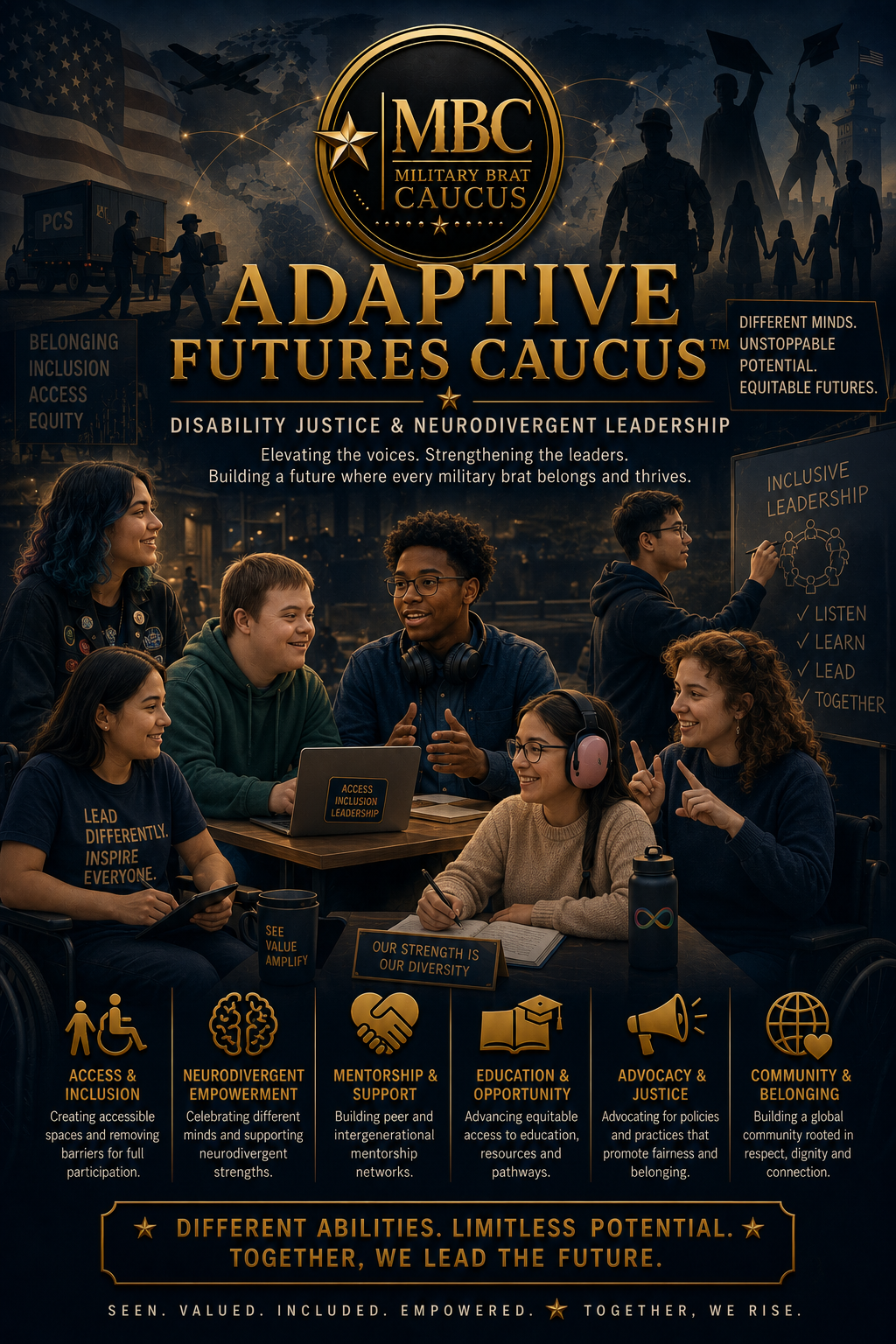
Adaptive Futures Caucus™ Disability Justice & Neurodivergent Leadership
Focus: Military brats with disabilities, neurodivergence, chronic health conditions, LGBTQ+ identities, and other marginalized experiences within military-brat community.
Purpose: Center military brats with disabilities and neurodivergence; advocate for disability justice and inclusion; challenge military culture stereotypes around ability and strength; create affirming community; develop accessible programming and advocacy.
Community Characteristics:
Military brats with physical disabilities, sensory disabilities, developmental disabilities
Neurodivergent military brats (ADHD, autism, dyslexia, mental health conditions)
Military brats with chronic health conditions or invisible disabilities
LGBTQ+ military brats navigating identity within conservative military culture
Military brats from marginalized racial, ethnic, religious backgrounds
Intersectional identities (e.g., disabled LGBTQ+ military brat of color)
Key Programs & Activities:
1. Disability Justice & Advocacy
Format: Monthly meetings + quarterly advocacy campaigns
Focus: Policy advocacy on disability rights, accessibility, mental health, LGBTQ+ rights
Issues:
Ensuring military-family policies are disability-accessible
Advocating for mental-health resources (especially for trauma, PTSD)
Supporting LGBTQ+ military-brat identity and family recognition
Challenging ableist stereotypes in military culture
Accessibility in military housing, schools, programs
Campaigns: Co-lead Military Brat Recognition Act™ push for disability inclusion; advocate for mental-health funding
2. Neurodivergence Support & Community
Format: Monthly peer support groups (organized by neurodivergent type: ADHD, autism, dyslexia, etc.)
Focus: Peer support, coping strategies, career/education navigation, social connection
Facilitators: Trained peer facilitators (neurodivergent military brats)
Accessibility: Multiple format options (virtual, in-person, async discussion boards)
3. Accessible Program Development
Training: Ensure all Brat Corps programs are fully accessible
Accessibility Standards:
All events have captions, ASL interpreters, accessible venues
Documents in multiple formats (PDF, large print, Braille, audio)
Flexible participation options (virtual, async, in-person)
Sensory-friendly spaces at events
Mental-health support and accommodations
Feedback Loop: Regular accessibility audits; feedback from disabled community members
4. Career & Education Pathways
Format: Workshops and mentorship on navigating college/careers as neurodivergent or disabled military brat
Topics:
Disclosure and disability accommodations in school/workplace
Finding neurodivergent-friendly employers
Career paths for disabled military brats
Combining military identity with disability identity
Mentors: Disabled military brats in various careers
5. Intergenerational Healing & Resilience
Format: Workshops on processing military trauma, disability, and identity intersections
Focus:
Processing military culture's shame around weakness/disability
Reframing disability and neurodivergence as identities (not deficits)
Building resilience and self-advocacy skills
Healing intergenerational trauma
Facilitators: Therapists, social workers, trauma specialists (ideally disabled military brats or military-family connected)
6. LGBTQ+ Military-Brat Network
Format: Monthly virtual community + annual summit
Focus: LGBTQ+ identity, family acceptance, dating and relationships, navigating military family conservatism
Activities: Support groups, social events, mentorship, policy advocacy for military-family LGBTQ+ inclusion
Membership Benefits:
Affirming community of disabled and neurodivergent military brats
Accessible programs and events
Peer support and mentorship
Career and education guidance
Advocacy and leadership opportunities
Mental-health resources and support
Participation Requirement: Military-brat identity + disability, neurodivergence, chronic health condition, LGBTQ+ identity, or other marginalized experience
Leadership Structure: Adaptive Futures Caucus Chair (elected annually) + Co-chairs representing major communities (disability, neurodivergence, LGBTQ+, racial/ethnic)
"Join Adaptive Futures Caucus™" → bratcorps.org/caucus/adaptive/join
ADAPTIVE FUTURES CAUCUS™
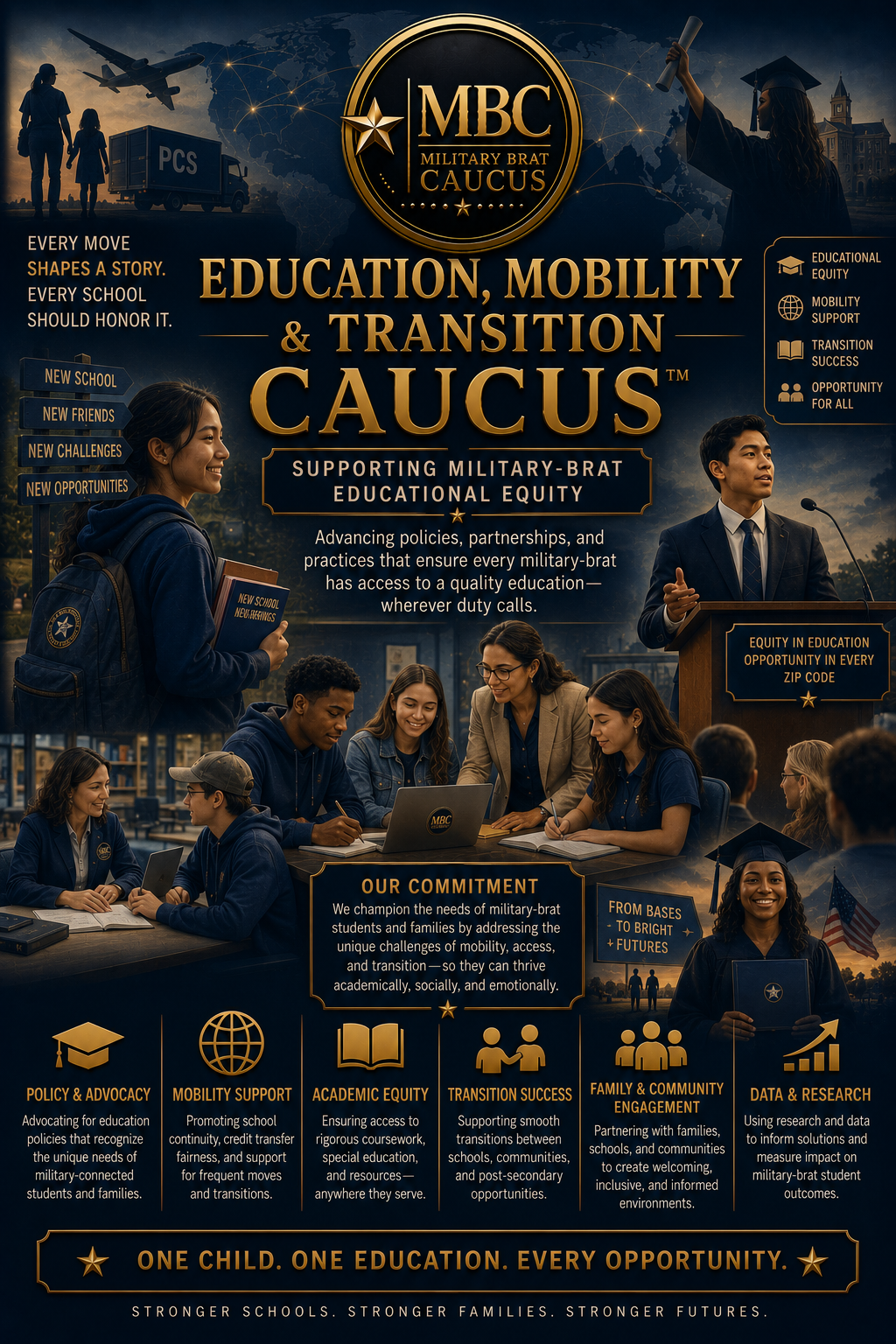
Education, Mobility & Transition Caucus™ Supporting Military-Brat Educational Equity
EDUCATION, MOBILITY & TRANSITION CAUCUS™
Educational and transition support for military-connected students; advocating for educational equity; addressing PCS move challenges; ensuring credit portability and educational continuity.
Purpose: Develop evidence-based solutions to military-brat education challenges; advocate for transition support and educational equity; build partnerships with schools, states, educators; ensure military-connected students have equitable education access.
Community Characteristics:
Educators serving military-connected students
School administrators and policy makers in military-heavy districts
Parents navigating military-family education challenges
Military-brat students and young adults reflecting on education experiences
Researchers studying military-connected education outcomes
Education nonprofits and advocates
Key Programs & Activities:
1. Educational Equity & Transition Support Policy Development
Format: Working group meetings (monthly) developing policy and best practices
Focus:
Credit portability across states (no lost credits for PCS moves)
Graduation flexibility for military students
Curriculum alignment across military-heavy states
Enrollment timeline standards (ensure quick enrollment at new schools)
Support for students during transitions
Output: Policy briefs, federal legislation, state-level initiatives, school best-practice guides
2. Educator Training & Certification
Format: Online training course (20 hours) for K–12 educators on military-connected students
Content:
Understanding military-brat identity and culture
Supporting transition and PCS move challenges
Mental-health awareness (deployment stress, transitions)
Curriculum that celebrates military-brat contributions
Working with military-family parents
Outcome: Certification; over 500 educators trained annually
Funding: Grants from military-family nonprofits, DoD education partnerships
3. School Administrator Network
Format: Online community and quarterly in-person summits for principals and district leaders in military-heavy areas
Focus: Best practices for serving military-connected students, resources, policy updates
Topics: Transition support programs, credit transfer, curriculum, mental-health resources, parent engagement
Outcome: Peer learning, resource sharing, district-level improvement initiatives
4. Student & Parent Transition Support
Format: Resources, guides, and peer support for students and families navigating PCS moves
Content:
Pre-move planning guide (choosing schools, curriculum review, social orientation)
At-move support (welcoming activities, academic catch-up, mental-health check-ins)
Post-move follow-up (6-month and 1-year progress monitoring)
Peer support groups for students in transition
Accessibility: Digital resources, in-person support at military bases and Brat Corps Posts™
5. Military-Family Liaison Training & Certification
Format: 40-hour training program for educators/administrators becoming military-family liaisons
Content: Military family issues, transition support, resource connection, family engagement, advocacy
Outcome: Certified liaisons at every school serving 20+ military-connected students
Goal: Every military-connected student has designated school contact who understands military family life
6. Research & Data Collection
Format: Partner with universities to track military-connected student outcomes
Metrics: GPA, graduation rates, college enrollment, mental health, transition stress, academic achievement
Output: Annual report on military-connected student outcomes; identify gaps and improvement opportunities
Use: Inform policy, funding priorities, program development
Membership Benefits:
Access to educator training and certification
Network of 500+ educators and administrators serving military families
Participation in policy development and advocacy
Resources and best-practice guides
Speaking and research opportunities
Leadership roles in school-level initiatives
Participation Requirement: Work in education sector (educator, administrator, counselor) OR parent navigating military-family education challenges OR researcher studying military education outcomes; military-family connection
Leadership Structure: Education Caucus Chair (educator or administrator) + Regional co-chairs (8–10), representing different regions and military-heavy states
"Join Education, Mobility & Transition Caucus™" → bratcorps.org/caucus/education/join
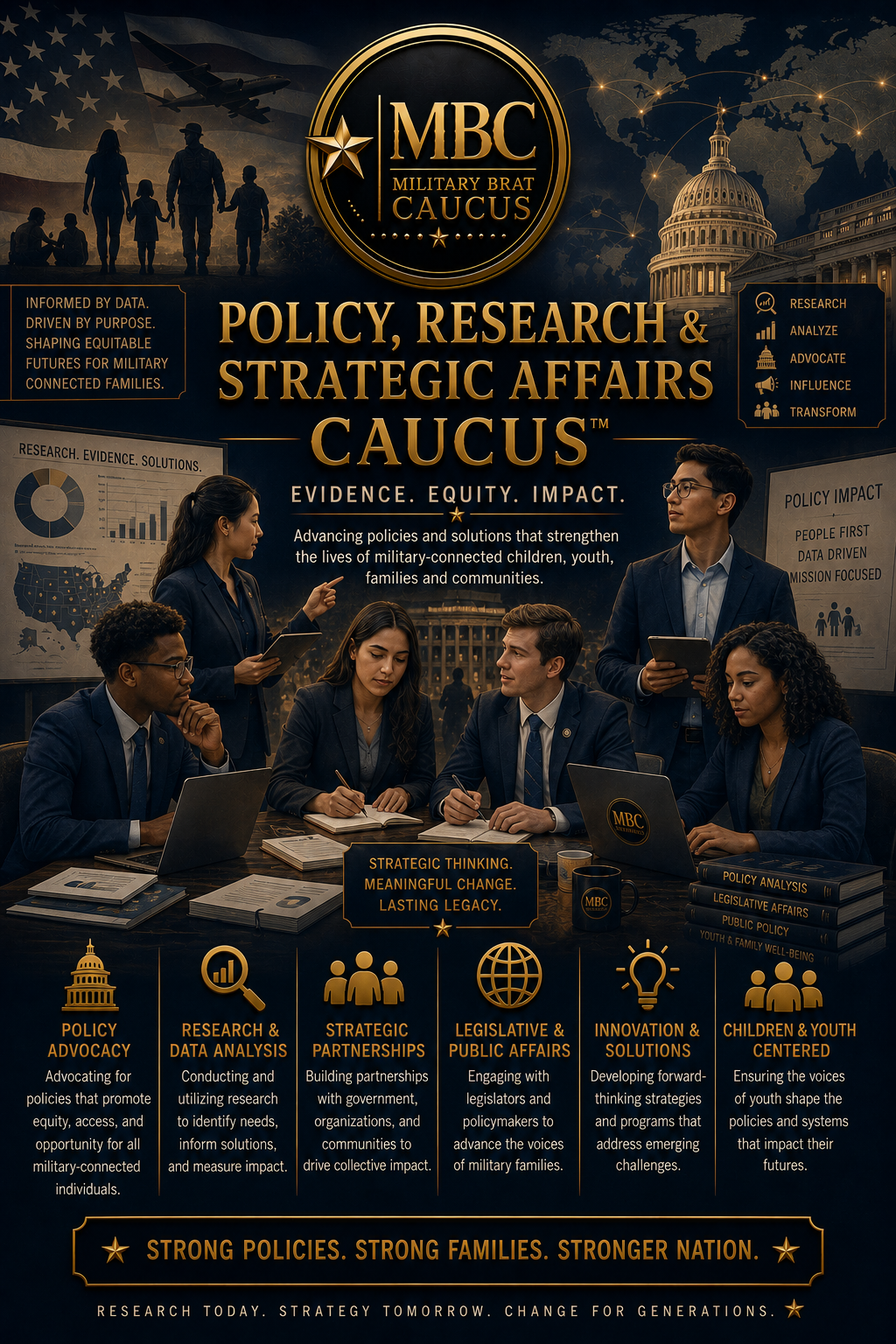
Policy, Research & Strategic Affairs Caucus™ Evidence-Based Military-Family Solutions
POLICY, RESEARCH & STRATEGIC AFFAIRS CAUCUS™
Focus: Research, policy development, and strategic planning on military-family issues; conducting original research; developing evidence-based legislation; partnering with academic institutions and federal agencies.
Purpose: Generate evidence-based solutions to military-family challenges; partner with researchers and universities; advise on military-family policy at federal and state levels; ensure Brat Corps advocacy is grounded in rigorous research.
Community Characteristics:
Researchers and academics studying military families
Policy analysts and think-tank professionals
Federal and state policy makers
Military medical and mental-health professionals
DoD and Veterans Affairs officials
Military-brat leaders with policy expertise
Data analysts and statisticians
Key Programs & Activities:
1. Research Partnerships & Grants
Format: Partner with universities (MIT, Stanford, UNC, Johns Hopkins, etc.) on multi-year research projects
Topics:
Military-brat mental-health outcomes and resilience
Educational equity and transition support effectiveness
Esports as youth development tool
Military-family well-being trends
International military-connected youth comparisons
Funding: Co-funded by Brat Corps® DAO treasury, federal grants, university funding
Output: Peer-reviewed publications, policy briefs, Congressional briefings
2. Policy Development & Legislative Drafting
Format: Working groups (monthly) developing policy proposals and legislation
Focus: Military Brat Recognition Act™, transition support policy, mental-health funding, educational equity, esports and youth programming
Process:
Identify problem/gap
Review research and evidence
Draft policy proposal
Stakeholder consultation (military, educators, parents, nonprofits)
Legislative drafting
Congressional sponsor recruitment
Advocacy campaign
Output: Legislation introduced, passed, implemented
3. Annual Military-Connected Esports & Youth Research Report
Format: Comprehensive research report released annually (March at Brat Corps® Summit™)
Content: Market analysis, demographic trends, outcome data, policy recommendations, international comparison
Distribution: Congress, military leadership, media, academic institutions, public website
Impact: Informs funding decisions, policy priorities, program development
4. Congressional Briefing Series
Format: Monthly briefings for Congressional staff on military-family research and policy
Location: Capitol Hill
Topics: Military-brat outcomes, transition support effectiveness, mental-health research, international comparisons
Speakers: Brat Corps® researchers, military-brat advocates, military leaders, nonprofit partners
5. Data & Analytics Hub
Format: Centralized database tracking military-brat outcomes across Brat Corps programs
Data:
Post member outcomes (engagement, mental health, academic, career)
Tournament participant demographics and outcomes
Advocacy campaign reach and impact
Program effectiveness metrics
Analysis: Annual analysis; shared with research partners
Privacy: All data de-identified and anonymized; strict privacy protocols
6. Strategic Planning & Foresight
Format: Annual strategic planning retreat (2 days, in-person)
Participants: 20–30 policy, research, military, and nonprofit leaders
Focus: Identify emerging military-family issues; develop multi-year strategy; plan for international expansion; anticipate policy opportunities
Output: Strategic plan (published); identifies priorities for next 3–5 years
Membership Benefits:
Leadership in research and policy development
Access to Brat Corps® data and populations
Collaboration with top researchers and policy makers
Co-authoring opportunities on publications
Speaking and testimony opportunities at Congress/conferences
Funding for research projects
Influence on national military-family policy
Participation Requirement: Advanced degree (Master's or PhD) or 10+ years in policy/research/military leadership; expertise on military-family issues
Leadership Structure: Policy & Research Caucus Chair (senior researcher or policy expert) + Co-chairs (research, policy, military liaison)
"Join Policy, Research & Strategic Affairs Caucus™" → bratcorps.org/caucus/policy-research/join